
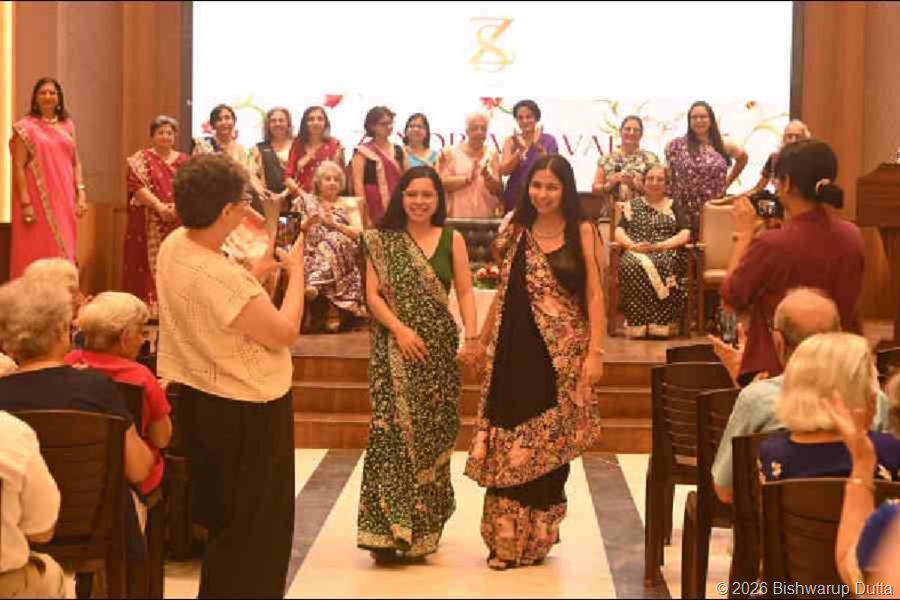
Many participants shared stories of their own heirloom Parsi Gara saris, some more than 200 years old
Heirloom pieces carry stories of generations past and must be restored and revived to keep that legacy alive, Mumbai-based craft revivalist and fashion designer Xenobia Davar told a gathering of women at a workshop on Sunday.
Many participants shared stories of their own heirloom Parsi Gara saris, some more than 200 years old.
Article by Jhinuk Mazumdar | The Telegraph India
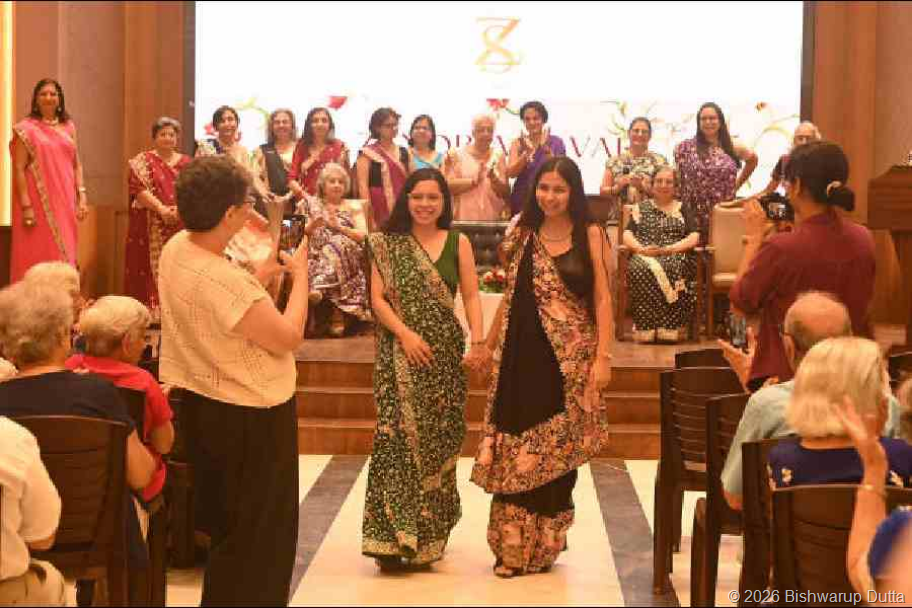
The exhibition of Gara-embroidered saris, kurtis and other artefacts on Sunday. Pictures by Bishwarup Dutta
The Calcutta Zoroastrian Stree Mandal organised the workshop and an exhibition as part of its 90th anniversary celebrations. The session focused on preserving and restoring the traditional Parsi Gara embroidery.
“When I hold an old heirloom in my hands to restore it, I feel the presence of generations before me. For me, Gara is not just an embroidered fabric but a piece of history and identity,” Davar said.
“Original Gara embroidery is done using sewing needles used at home, not the hook needles used commercially,” she said.
The workshop introduced participants to a variety of stitches and ways to restore Gara saris passed down through generations. Each stitch carries patience, precision and meaning, Davar said.
She also shared tips on preserving the delicate textiles. “To preserve them, I tell people not to iron the fabric because it may damage the sari. If the fabric loses strength over the years, there are ways to transfer the embroidery to another textile,” she said.
Several women, including some who were not Parsis, brought their inherited Gara saris to the workshop.
“Organising this programme was part of our 90th anniversary celebrations. Many of us possess Gara saris that are part of our heritage, but do not know how to preserve them. They are handed down from one generation to another but often remain unused because we do not know how to restore them,” said Yasmin Panthaki, a member of the Calcutta Zoroastrian Stree Mandal.
In many families, the saris are not worn for fear of damaging them, Panthaki said. “We avoid wearing them because we think we might spoil them. But the idea is to wear them, revive them and, at the same time, preserve them,” she said.
In many families, the saris are not worn for fear of damaging them, Panthaki said. “We avoid wearing them because we think we might spoil them. But the idea is to wear them, revive them and, at the same time, preserve them,” she said.
The Calcutta Zoroastrian Stree Mandal (CZSM)was founded by 12 Parsi women in 1936, said Havovi Khambatta, another committee member.
“The CZSM provides medical care, organises health camps and awards scholarships to members of the community and others. There are barely 350 Parsis left in the city, but despite our dwindling numbers, we remain as enthusiastic about our work as we were in the past,” Khambatta said.


