
Parsis in Modern India: Navigating Cultural and Socio-Economic Pathways
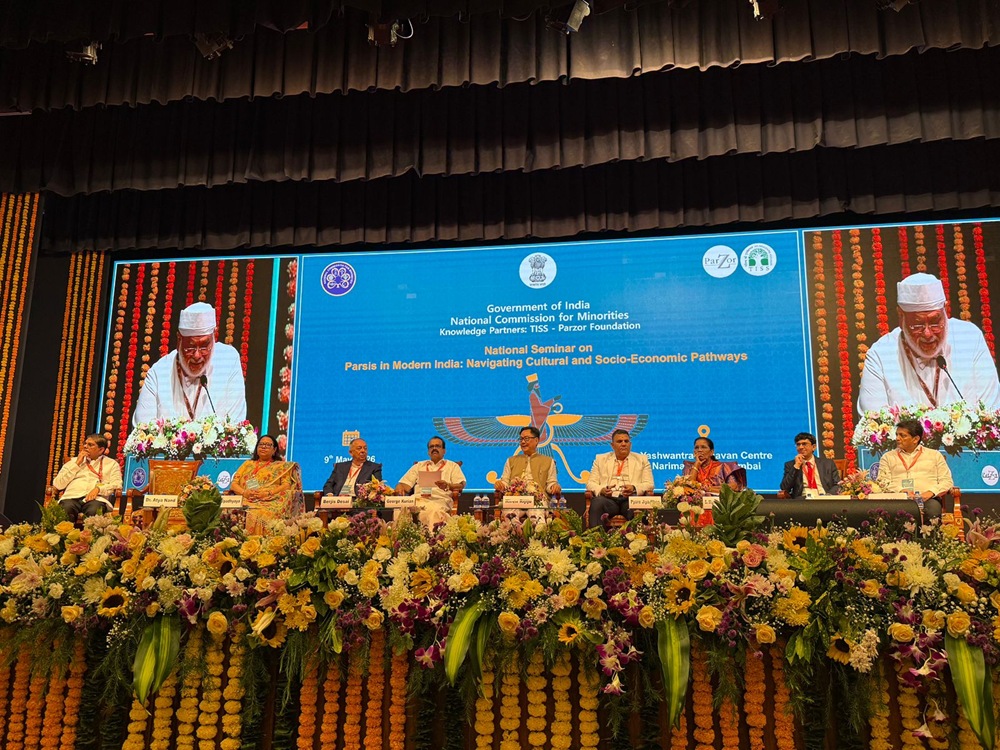
A significant national conversation on the future of the Parsi community unfolded in Mumbai on May 9, 2026, as the National Commission for Minorities (NCM) organized a major seminar titled “Parsis in Modern India: Navigating Cultural and Socio-Economic Pathways” at the Yashwantrao Chavan Centre. The gathering brought together Union ministers, scholars, industrialists, philanthropists, community leaders, and policymakers to discuss the demographic, cultural, and socio-economic realities facing India’s Parsi Zoroastrian community.
The seminar formed part of a broader series of academic engagements initiated by the NCM earlier this year to examine the evolving status of minority communities across India. Throughout the day-long event, one message emerged repeatedly: while the Parsi community’s numbers may be shrinking, its contribution to India remains immeasurable.
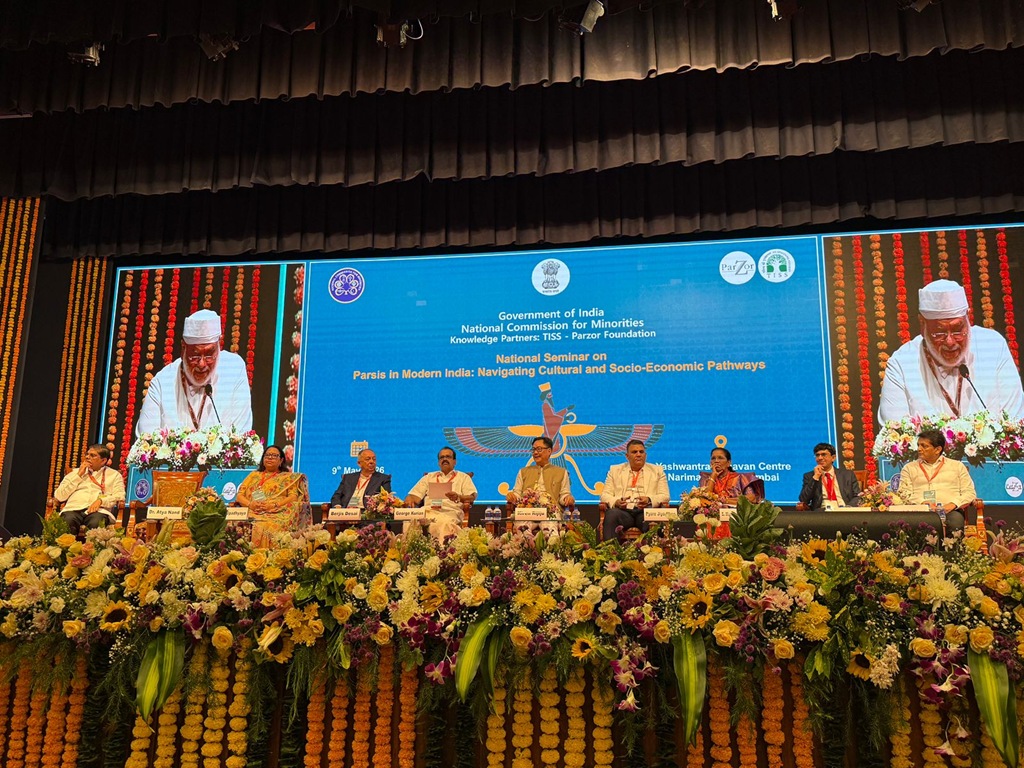
The proceedings opened with blessings invoked by Vada Dasturji Khurshed Dastur, setting a solemn and reflective tone for the discussions that followed.
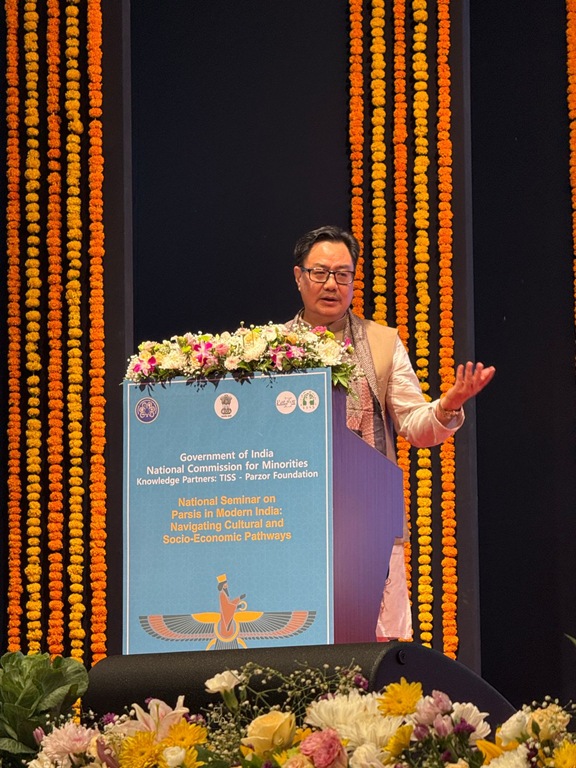
Chief among the dignitaries present was Shri Kiren Rijiju, Union Minister of Parliamentary Affairs and Minority Affairs, Government of India, who reaffirmed the Government of India’s commitment to preserving Parsi heritage and addressing the community’s declining population. Calling Parsis a community whose impact far exceeds its numbers, Rijiju praised the community’s role in shaping India’s industrial, philanthropic, legal, and sporting history.
“The government remains committed to preserving its heritage and socio-economic welfare,” Rijiju said, while highlighting efforts to rejuvenate the Avestan language and strengthen initiatives aimed at addressing demographic decline. He recalled how the Tata family sponsored India’s 1920 Olympic teams and how Parsis fielded the first Indian cricket team in the 1880s.
“It is not just about numbers; it is the impact that matters,” Rijiju added, referencing Prime Minister Narendra Modi’s vision of “Sabka Saath, Sabka Vikas, Sabka Vishwas, and Sabka Prayas.” He also invited suggestions from the community regarding the future direction of the Jiyo Parsi scheme.
Shri George Kurian, Minister of State for Minority Affairs, Government of India, echoed those concerns, emphasizing the need for coordinated responses to demographic sustainability.
“These are complex issues that call for a thoughtful and coordinated response, involving both policy support and active community participation,” Kurian said.
NCM Secretary Alka Upadhyaya highlighted the Commission’s longstanding engagement with issues affecting the community, including demographic challenges, preservation of cultural heritage, and access to welfare schemes. Meanwhile, Berjis Desai, Member of the National Commission for Minorities, reflected on the extraordinary role Parsis have played in shaping modern India’s economic, industrial, legal, and philanthropic foundations despite being one of the country’s smallest minority communities.
One of the seminar’s most emotional reflections came from Viraf D. Mehta, Chairperson of the Bombay Parsi Punchayet, who later described the gathering as “one of those days that stays with you.”
Writing after the event, Mehta reflected on the significance of seeing senior government leaders publicly acknowledge the community’s existential concerns.
“The numbers are stark. Only 1 family in 9 has a child below the age of 10. Our total fertility rate is below replacement level. In 1941, we had a population of 1,14,000. By the 2011 Census, that number had dropped to 57,264 Parsis. A decline of 10 percent per Census.”
Mehta spoke candidly about the deeper issues underlying the demographic crisis: hidden poverty, medical and socio-cultural challenges, delayed marriages, and increasing numbers of elderly Parsis living without adequate support systems.
Yet he also emphasized the importance of the Government of India’s visible engagement with the community’s future.
“What also happened yesterday was that the Government of India, through the Ministry of Minority Affairs, showed us that we are not invisible. That our survival matters.”
Mehta strongly advocated for the revival and strengthening of the Jiyo Parsi programme, describing it as “the only programme designed by the Government for us” and one that “needs to be rigorously restored and brought back with the force it once had.”
He also pointed toward heritage preservation and tourism as important pathways for sustaining community identity. From Diu to Dahanu, he envisioned heritage tourism circuits built around Parsi history, cuisine, embroidery, architecture, museums, and cultural traditions.
“These are threads that connect us to who we are, and they can add to the Incredible India tourist circuits.”
Among the most substantive presentations of the seminar was an address by Dinshaw Tamboly, Chairman of the World Zoroastrian Organization Trust Funds, who offered a sobering analysis of what he described as the intertwined crises of demographic collapse and rising economic vulnerability within the community.
Drawing upon historical census data, Tamboly traced the community’s trajectory from 89,490 Parsis recorded in the first Indian census of 1891 to a peak of 114,791 in 1941, followed by decades of uninterrupted decline. By 2001, the population had fallen to 69,601, and by the 2011 Census to just 57,264.
Tamboly warned that if current trends continue — approximately an 18 percent decline per decade — India’s Parsi population could fall below 10,000 by the beginning of the next century.
“Shocking, but not surprising.”
He explained that the community’s ageing demographic profile has created a severe imbalance, with relatively few younger Parsis in the reproductive and working-age groups compared to a growing elderly population dependent on support systems.
Tamboly identified delayed marriages, low marriage rates, intermarriage, infertility, and the high cost of fertility treatment as key factors contributing to the demographic crisis. He also presented Mumbai municipal data showing deaths outnumbering births by staggering margins between 2009 and 2013. In 2010, for example, there were only 210 births compared to 933 deaths.
However, Tamboly’s address extended beyond demographics to confront a subject often overlooked in public discussions about Parsis: poverty.
Referencing the landmark Tata Institute of Social Sciences report on the socio-economic status of the Parsi community, Tamboly challenged the common perception that all Parsis are affluent.
“Contrary to general belief, there is a small fraction of the community which exists even below the poverty line.”
He described how ageing demographics, unemployment, illness, fragmented welfare systems, and inadequate coordination among charitable institutions have led to growing economic vulnerability among sections of the community. Female-headed households, elderly dependents, and families with chronic illness were identified as particularly at risk.
Tamboly also called for greater coordination among Parsi charitable trusts and institutions, criticizing inconsistent welfare mechanisms and the exclusion of certain groups — particularly Parsis married outside the community and their children — from community support structures.
In a powerful appeal, he urged institutions to move beyond fragmented dole-based systems toward dignity-oriented approaches centered on vocational education, counselling, interest-free loans, and coordinated welfare intervention.
“A notional amount does no good either to the organisation extending it or to the beneficiary, who is made to feel like a beggar in the process.”
Tamboly concluded by urging the Government of India and the National Commission for Minorities to support new socio-economic surveys of Parsis in rural Gujarat and economically weaker housing colonies in Mumbai, and to revitalize the Jiyo Parsi programme through a high-powered committee drawn from within the community itself.
The seminar also featured two major technical sessions examining cultural preservation and socio-economic realities. Speakers explored subjects ranging from the preservation of Avesta and Pahlavi languages to Parsi textile traditions, philanthropy, architecture, heritage conservation, and education. Contributors included Kerman Fatakia, Tinaz Nooshian, Dr. Meher Mistry, Kerman Daruwalla, Prof. Shalini Bharat, Pearl Mistry, Prof. Nasreen Rustomfram, and others.
A short film celebrating the history and contributions of the Parsi community was screened during the event, and a coffee table book documenting the community’s legacy, achievements, and demographics was formally unveiled.
By the close of the seminar, the tone was both reflective and urgent. The demographic realities facing the Parsi community are stark, but so too is the growing recognition — both within government and the community itself — that preserving one of India’s most influential minority communities will require coordinated action, institutional courage, and long-term commitment.
As Viraf D. Mehta wrote in his reflections after the seminar:
“The question is not whether we can survive. It is whether we will act with the urgency this moment demands.”


