
Exclusion of intermarried women or their children contradicts the core tenets of Zoroastrianism and the Indian Constitution
Article by Jean D’Cunha | UCA News
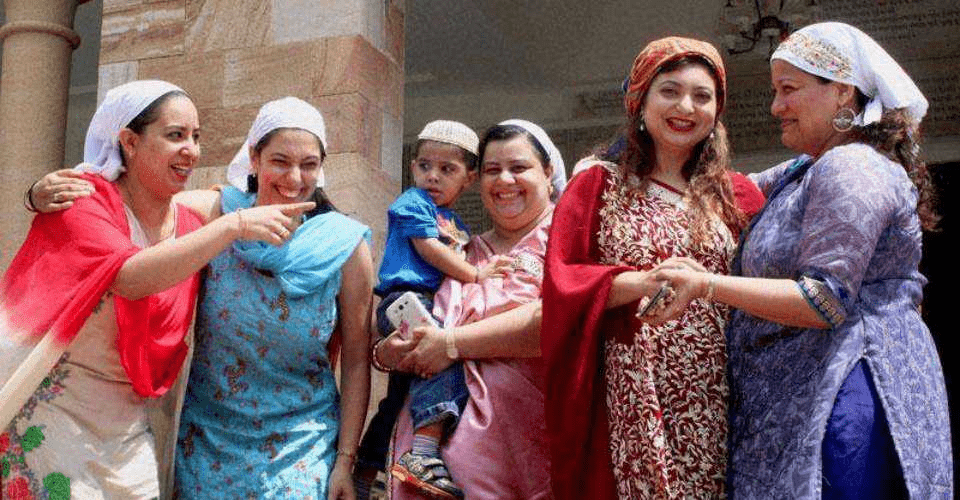
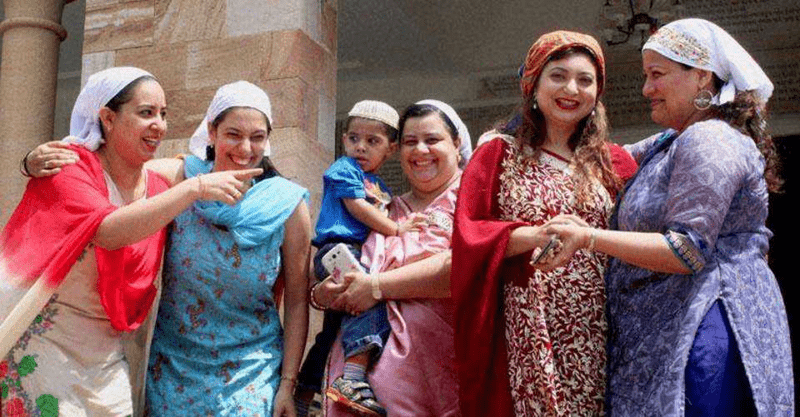
A file picture showing Parsi women during a festival celebration in India. As per tradition, a Parsi woman loses her religious identity after marriage outside the community and is consequently barred from visiting the Fire Temple or Tower of Silence in the event of the death of her Parsi family members. (Photo: thewire.in)
The Parsi Zoroastrian community in India, a small minority community that has wielded immense historical and economic influence, is at a crossroads in its history. The tensions between its celebrated contributions to India and perceived liberalism are at variance with a cascade of lost rights of many Parsi Zoroastrian women who marry outside the community.
As of April this year, a billion eyes are riveted on the nine-member constitutional bench of India’s Supreme Court who will opine on whether denying Parsi Zoroastrian women their socio-economic and religious rights on marriage to non-Parsis is — as advanced by orthodox elements of the community — a question of an essential religious practice and the community’s right to religious freedom as enshrined in Articles 25 and 26 of India’s Constitution.
The bench is reviewing this alongside other landmark issues, including the 2018 Supreme Court verdict lifting the ban on women entering the Sabarimala temple, the entry of women into mosques, and female genital mutilation/cutting of girls and women among Dawoodi Bohras.
In Goolrokh M. Gupta v. Burjor Pardiwala (2017), the Supreme Court rejected a Gujarat High Court ruling that applied the “doctrine of coverture,” which claimed a woman’s religion merges with her husband’s upon marriage.
Goolrokh was previously denied access to the Fire Temple and Tower of Silence for her parents’ funerals. The apex court clarified that marrying a non-Parsi man under the Special Marriage Act does not result in the loss of religious identity. While directing the Valsad Trust to permit her attendance through an interim order, broader constitutional questions of religious identity now stand before the nine-judge constitutional bench of the Supreme Court.
In Dina Budhraja v. Nagpur Parsi Panchayat, the petitioner challenged Rule 5(2) of the Nagpur Panchayat (Council), which strips Parsi women of religious identity and temple access upon marrying non-Parsis. The case arose after Budhraja was barred from performing her grandmother’s funeral rites in 2024.
Echoing Goolrokh Gupta, the Supreme Court observed that a woman’s religious identity and DNA remain unchanged by marriage under the Special Marriage Act. The Court issued notices to the Panchayat and Federal Government to examine the rule’s constitutional validity. Currently, it is considering interim relief to grant Budhraja temple access and ritual participation during the ongoing legal battle.
Both women challenged this discrimination as violating the Constitutional Article 14 (Equality), noting that Parsi men face no such “excommunication” or exclusions for marrying outside the faith. They further argued that Article 25 (Religious Freedom) and Article 21 (Dignity) cannot be revoked by community bodies based on marital choice.
Petitioners contend the exclusionary rule is not an “essential religious practice,” as Anjumans (governing bodies for the local community) in Delhi and Kolkata do not enforce such bans. They demand that the apex court strike down these discriminatory practices in favor of universal, constitutionally valid standards that protect women’s fundamental rights within the community.
Says Daulat Jehangir, an Irani Zoroastrian and a practicing high court lawyer, married to a Hindu, “I have never personally faced such discrimination as I am known to pull my weight against it. But I do know that Parsi Zoroastrian women marrying outside the faith may be barred from entering the Fire Temple and denied the right to have their funeral rites performed at the Tower of Silence. Denial of funeral rights at the Tower of Silence generates a state of ‘spiritual limbo’ as a woman who has practiced Zoroastrianism since her Navjote [initiation] is treated as a religious outsider on marriage to a non-Zoroastrian. Also, as a lawyer, I wish to add that when the State has created the Special Marriage Act, specifically to ease inter-religious marriage, as India is a union with diversity, then why are Zoroastrian women stripped of it by a Panchayat, which is no more than a khap [caste council]? How can a Panchayat be above the laws of a country?”
Nev March’s historic novel Murder in Old Bombay points to many intermarried Parsi women becoming ineligible for benefits such as subsidized housing, or medical assistance, provided by some of the charitable trusts managed by the community.
Many intermarried Parsi women become ineligible for benefits such as subsidized housing or medical assistance, provided by some of the charitable trusts managed by the community.
Furthermore, Penny Jacob, a Parsi Zoroastrian by birth and married in 1965 to a to a non-Parsi says, “gender discrimination also extends to the next generation. Children of Parsi men married to non-Parsi women are accepted in the community, while those of Parsi women married to non-Parsi men are not allowed to undergo Navjote (an initiation ceremony).”
Reportedly children of intermarried Parsi women are excluded from Parsi-only trust benefits and housing, as they are not recognized as Parsis.
This exclusion stems from a 1908 Bombay High Court judgment, which archaically viewed intermarriage as “contaminating the gene pool.” Recently, a minor child filed a Supreme Court writ petition via the Parsi Zoroastrian mother married to a non-Parsi, under Article 32, which guarantees every Indian citizen the right to approach the Supreme Court directly if their fundamental rights are violated, to strike down this ruling as “bad law.” The ongoing case challenges the 1908 precedent for violating constitutional protections against discrimination based on sex and race, while infringing upon the fundamental rights of women and children.
Critics and liberal scholars argue that Zoroastrianism’s core — “Good Thoughts, Good Words, and Good Deeds” — emphasizes individual choice and universal ethics over exclusion. Scriptures do not deny spiritual grace to intermarried women or their children. These bans are 19th-century social constructs rather than theological mandates.
The defense of these practices as “essential religious practices” is a misnomer, evidenced by the inclusionary policies of the Delhi and Kolkata Anjumans. To claim that gender-based exclusion is fundamental to the faith suggests that inequality is its bedrock, which contradicts the core tenets of Zoroastrianism, making these restrictive customs a violation of both faith and constitutional principles.
Finally, at a more demographically expedient level, data suggests that the community is dwindling in size, and that an estimated 35 percent to 40 percent of Parsi marriages in cities like Mumbai are now exogamous. By excluding the children of intermarried women, the community is effectively excluding much of its potential future population, accelerating its own demographic extinction.
*Dr. Jean D’Cunha is a gender expert with a continuing body of work on women’s labor migration and the links among gender, climate change, conflict, and migration. She worked with UN Women in senior management and technical roles worldwide and retired as Senior Global Advisor on International Migration and Decent Work. She currently advises the Catholic Bishops’ Conference of India (CBCI) Office for Environment and Climate Change and the Federation of Asian Bishops’ Conferences on COP 30 (Global Conference of Parties 30 on Climate Change. The views expressed in this article are those of the author and do not necessarily reflect the official editorial position of UCA News.


