
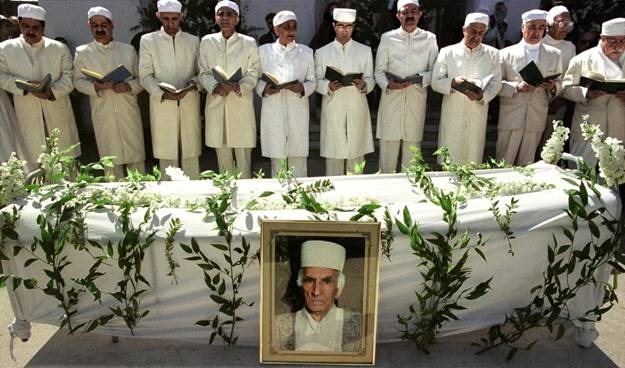
The West has no structures or legal precedent for corpses to decay in the open air. For those wishing to follow traditions, funerals are a compromise.

Zoroastrian priests pray for the religious leader of the Iranian Zoroastrian community Dastur Rostam Dinyar Shahzadi during his funeral in Tehran on March 15, 2000 at the Zoroastrian Qasr-e-Firoozeh cemetery.(HENGHAMEH FAHIMI/AFP via Getty Images)
Article by Nevin Kallepalli | Juggernaut
“They took her body and entered the Tower of Silence,” said Arzan Sam Wadia of his mother, who passed away five years ago. “That was the last memory I was left with.” His family watched four pallbearers, called nāsālārs, carry his mother’s body through a 300-year-old gate amid lush foliage in a neighborhood of Mumbai, India, isolated from the city’s bustle.
The ritual details of Zoroastrian funeral rituals are complex but have remained consistent for millennia. On the grounds of Malabar Hill, where the Tower of Silence stands, are large chambers called bunglis, where priests, called mobed in Farsi, transferred, washed, dressed, and laid the corpse on marble slabs. During the public rites, the mobed traced the perimeter of her body three times with an iron nail to demarcate a zone of impurity. A dog, which is highly revered, gazed upon her face to confirm that she was truly dead. After the pallbearers took her body, Wadia returned to the bungli with his family to continue prayers. He spent four days at the Tower of Silence from beginning to end.
Towers of Silence, called dakhma in Farsi, are the architectural structures where Zoroastrians traditionally perform their final rites, where corpses are left to decompose under the sun. Historically, dakhmas were erected in places with sizable Zoroastrian communities — in Iran, Central Asia, and the Indian subcontinent. As the Vendidad, a central text of Zoroastrianism, says, burying or cremating a body defiles the earth with dead matter. Towers of Silence, then, align with a core principle of Zoroastrianism: leave no trace on the Earth. But for Zoroastrians in the West, they have little choice but to compromise their traditions with their reality.
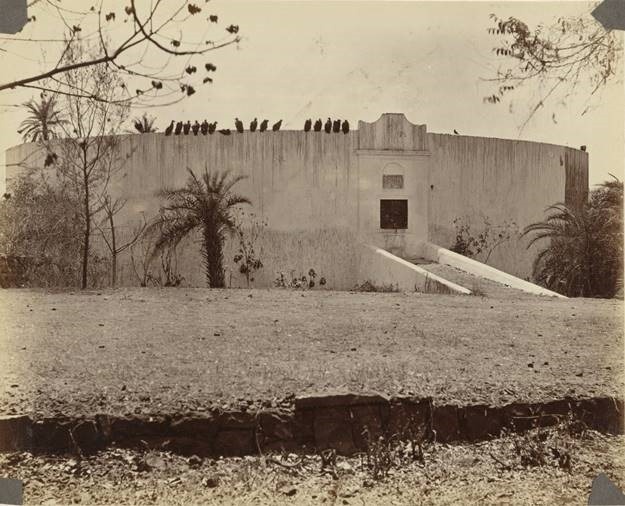
Towers of Silence on Malabar Hill in Bombay (Mumbai). On the structure, vultures eating the deposited corpses. (Sepia Times/Universal Images Group via Getty Images)
The practice of excarnation — removing all flesh and organs off the skeleton before burial, often by natural means — has been common among Zoroastrians since the 5th century B.C. in ancient Persia. Following the Islamic conquest of the Middle East in the 7th century, many Zoroastrians migrated. In South Asia — where they are called “Parsis” meaning “Persian” in Indic languages — they built dakhmas in Karachi, Mumbai, and Ahmedabad. Today it is only in India, not Iran, that dakhmas are still in use. The last body laid to rest according to Zoroastraian tradition in Iran was in 1979, just before Ayatollah Khomeini, as head of a new Islamic government, abolished the practice after the fall of the Shah.
In the not so distant past, dakhmas relied on the once abundant population of Indian vultures to consume the bodies. But in the 1990s, the introduction of Diclofenac, a drug used to treat bovine inflammation, pain, and fever, almost entirely decimated the scavenger birds, prompting Zoroastrians in Mumbai, Hyderabad, and Gujarat to introduce solar reflectors to aid the decomposition process. During the monsoon season, when sunlight is in short supply for months, purely relying on solar power isn’t always an ideal option. Some have favored cremation amid recent ecological shifts, provoking a spiritual debate between traditionalism and reform. Today, Diclofenac is illegal, but similar bovine drugs continue to threaten vultures.
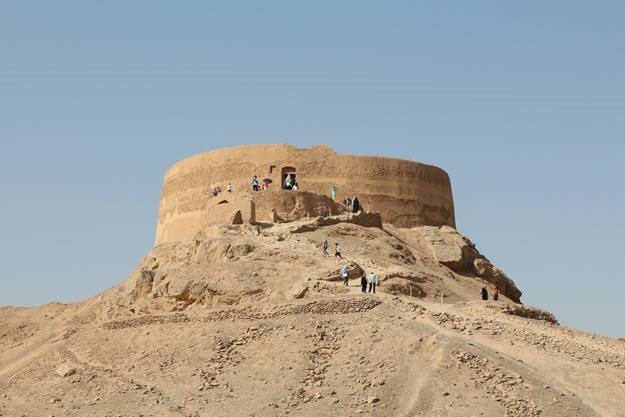
The western Tower of Silence, Yazd, Iran, 2016 (Bernard Gagnon, Wikimedia Commons)
Zoroastrians who have migrated to North America from the 20th century onward are left to compromise their final rites because there are no functioning Towers of Silence in the Western hemisphere, resorting to either burial or cremation. The possibility of building Towers of Silence in the U.S. seems far off, but is not entirely impossible. The legal precedent would follow a larger historical trend in which “disposition of the dead” has become more inclusive of practices alternative to Christian burial.
Wadia recalled the memory from his office in New York City, where he works as an architect and serves as the current president of the Federation of Zoroastrian Associations of North America (FEZANA). If given a choice, he hopes to one day join his mother’s spirit in the very same structure, which remains among the last in the world.
“If we can eat animals, why can’t animals eat us?”
— Tehemton Mirza, mobed from Ontario, Canada
Opinions differ on the importance of retaining this practice. Other workarounds practiced in the diaspora are burying the body and lining it with stone, so that the impurity of the corpse does not contaminate the ground around it. A mobed named Tehemton Mirza from Ontario, Canada, chuckles as he considers what arrangements he’d like to make postmortem. Some from his own congregation choose to cremate.
“I turned 71 today, and I feel I still have a bit of time left,” he shared. He considered offering his body as a gift, informing his decision to donate his organs. “Charity is a very important principle in Zoroastrianism,” he explained. Just like one would offer their body to hungry vultures as a final act of charity, he believes organ donation aligns with the same logic. He also supports those who wish to follow traditional practices. “If we can eat animals, why can’t animals eat us?” he added.
“Zoroastrianism was the first environmentally conscious religion,” Mirza and other scholars believe.
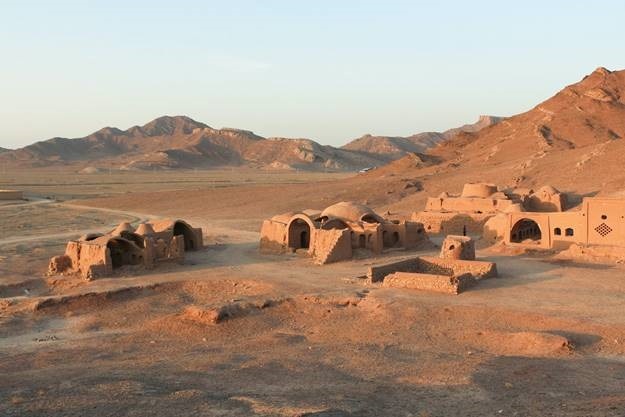
Ritual buildings under the Tower of Silence in Cham, Iran (Bernard Gagnon, Wikimedia Commons)
In 2006, a Parsi reformist, Dhun Baria snuck into the Tower of Silence in Malabar Hill (a gutsy violation of dakhma code — under no circumstances can non-priests enter) and photographed the corpses in a stagnant stage of decay. She distributed the photographs and shocked the Zoroastrian world — previously, vultures would have accelerated the decay, but now the process was taking months.
This prompted demands to build a crematorium on the grounds of Malabar Hill, which were ultimately denied. A Parsi-specific burning site was eventually established elsewhere, yet cremation deeply divided the community. Burial and cremation are common practices among Zoroastrians in places where there are no dakhmas — but many orthodox practitioners believe it is blasphemous to choose not to be excarnated when it is an option.
“Like all faiths, there are liberals, and there are conservatives…even among the priestly class.”
— Behram Panthaki, a mobed in Virginia
“Like all faiths, there are liberals, and there are conservatives…even among the priestly class,” said Behram Panthaki, a mobed and retired brigadier in the Indian army who now resides in Falls Church, Virginia. His father, too, was a mobed. He considers himself someone who prioritizes the practicality of one’s circumstance over adherence to the past. “If religion is to survive,” he shared, “it must move with time.” In the Washington, D.C. area where he lives, there are a number of designated plots for Zoroastrians in the Park Lawn cemetery in Maryland. He’s opting for cremation. Pathanki’s final wish is for his ashes to be spread in the Rocky Mountains.
Zoroastrians living outside South Asia, including Wadia, Mirza, and Pathaki, will have to turn to what is available when it comes to their last rites. As of now, legislation for the construction of a tower stateside isn’t a real possibility.
That said, the legislation of “final dispensation,” or funerary arrangements, has evolved tremendously over the past 200 years, according to Tanya Marsh, a law professor at Wake Forest University and expert on the statutes that dictate the disposal of dead bodies in the United States.
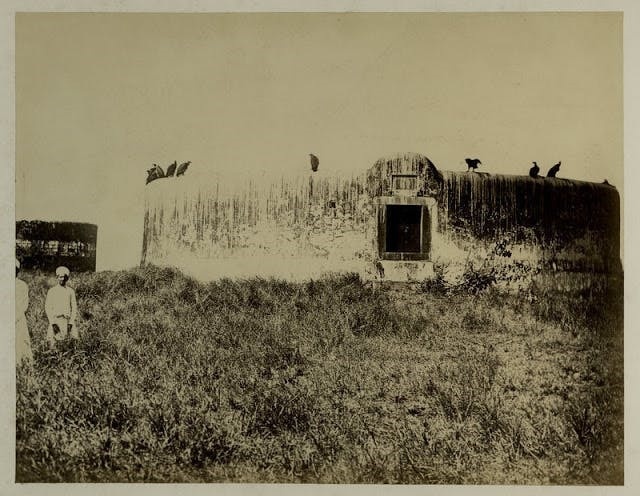
Tower of Silence in Bombay, 1880
Before European settlement, Indigenous peoples had a long tradition of excarnation similar to Zoroastrians. As colonizers swept across North America, they codified Judeo-Christian burial. “The law is facially neutral, but at the same time it institutionalizes the social norms that existed for 17th century Protestants,” said Marsh, and that baseline bias toward burial still affects how statutes are structured today.
Despite cremation being a common practice in Dharmic cultures for millennia, the first crematorium wasn’t built in the U.S. until 1876 in Washington, Pennsylvania. This practice was adopted by progressive social reformers for sanitary, not religious reasons. At the time, advocates of cremation believed that corpses could spread contagious disease through the soil and groundwater if buried.
Recently, environmentally-conscious alternatives to burial have expanded the constraints of disposition legislation. “In the past 10 to 15 years, we’ve seen alkaline hydrolysis [dissolving the body] legalized in 28 states, and the last three years we’ve seen composting,” said Marsh.
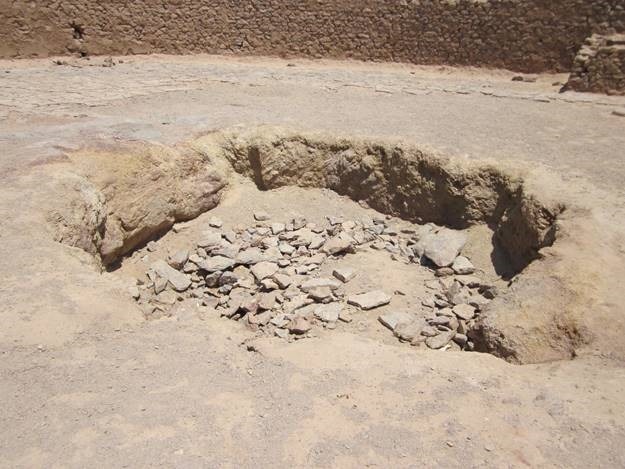
The central pit of the (now-defunct) tower of silence at Yazd, Iran (Petr Adam Dohnálek, Wikimedia Commons)
Excarnation has yet to be addressed. As it stands in some state laws, the use of a dakhma would be considered “desecration of a body,” since the open exposure of a corpse is currently illegal. Despite this, researchers at Texas State University and elsewhere have ranches where donors give their corpses to forensic scientists to study their decomposition in open air, suggesting that the law can be amended to accommodate the needs of certain communities.
Marsh believes in the power of people choosing how they are laid to rest — no matter who you are.
“If you believe that the spiritual future life of your loved one is dependent upon a specific method of disposition and then you’re told you can’t do it…that’s very disturbing.”
Correction: An earlier version of this article misspelled Behram Panthaki’s last name. That instance has since been corrected.
Nevin Kallepalli is a religion reporter based in New York City.


