
“Was N.F. Suntook a Parsi?” I asked Mr. Vappala Balachandran, former Special Secretary, Cabinet Secretariat, who also worked in India’s intelligence services.
He replied: “Yes. Noshir Framji Suntook was the longest-serving R&AW (India’s foreign intelligence agency) chief. He was from Bombay. He had married the late Pocha’s (famous Pocha seeds, Pune) daughter. I had worked very closely with him.”
I wrote back: “Do you have more info on Suntook? Most Parsis have never heard of him.”
Mr. Balachandran sent me this interesting piece on Suntook, which he wrote many years ago.
Article by Nauzer Bharucha via Facebook.
On April 10, 1983, a Bombay newspaper, once the city’s Fourth Estate leader, announced with banner headlines: “India’s Top Spy Missing: Biggest Escape Since Philby — US Suspected Destination — Panic in Ruling Party.” Their New Delhi correspondent reported that Naushervan Framji Santook, India’s “master spy,” head of the Research & Analysis Wing (RAW), “defected to an as yet unknown country with some super sensitive documents.”
It mentioned that the passenger manifest revealed that he, accompanied by his wife, took the flight on March 30 to the USA. The report quoted a senior intelligence officer as saying that “Santook’s defection” was “conclusive evidence of a major penetration of the country’s counter-intelligence by an as yet unknown foreign espionage network.” It said further: “While almost all that RAW did and had would now be the property of the country of adoption of Santook, according to this intelligence officer, nothing like this in the cloak and dagger world had happened anywhere since the defection of British MI6 double agent Kim Philby over two decades ago.”
This “defector” spy was none other than the late Noshir Framji Suntook, a former naval officer who joined the Indian Police Service after Independence. In the early 1950s, while working in the Bombay Presidency, he volunteered to serve in the unpopular Andaman Islands, where he did pioneering work in befriending the remote “Jarawa” tribe instead of following the traditional hostile police policy. In 1957, he opted to go to the North East by joining the Indian Frontier Administrative Service (IFAS), successor to the British Indian Political Service. He soon learnt the complexities of that region.
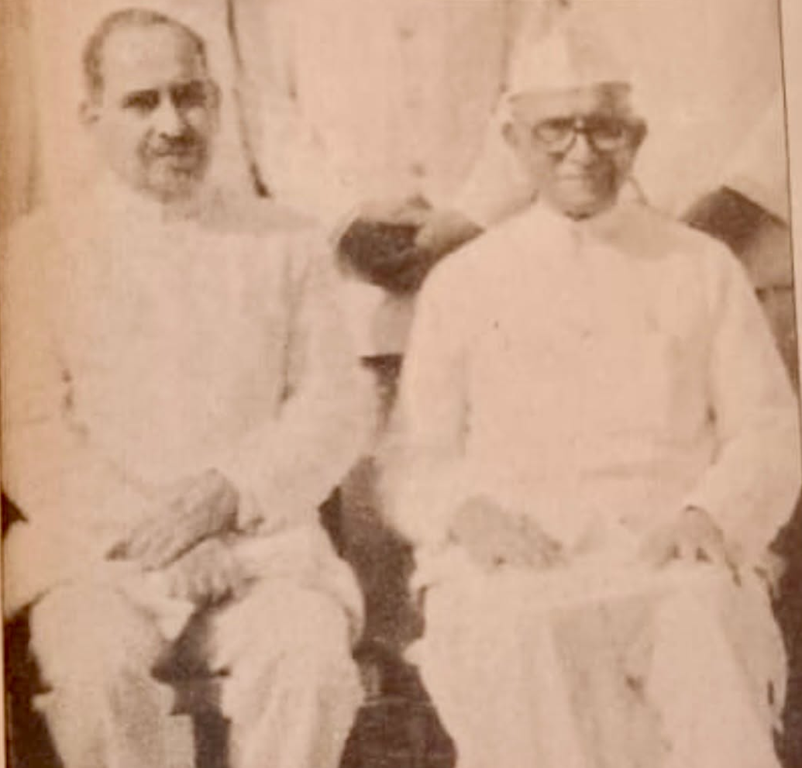
(Pic: Suntook seated with Prime Minister Morarji Desai)
In 1968, the legendary R.N. Kao chose him to head an important wing when he set up our foreign intelligence department (RAW). In 1977, Suntook was selected by Prime Minister Morarji Desai to head RAW after a major purge following Mrs. Indira Gandhi’s defeat in 1977. He then became the second longest-serving RAW chief (1977–1983). During this period he also frustrated a surreptitious move by some elements in our foreign ministry who, by taking advantage of the inexperience of the Janata government, tried to persuade them to sign the Nuclear Non-Proliferation Treaty against India’s traditional stand. (Sunday Guardian, September 19, 2010)
It was a testimony to his apolitical service and integrity that Mrs. Indira Gandhi chose to retain him in this sensitive assignment after storming back into power in January 1980, although he had worked closely with her political rivals. Suntook was to retire from service on March 31, 1983. He was to hand over charge to Girish Chandra “Gary” Saxena, later Governor of Jammu and Kashmir twice. However, just before the formal transfer of charge, Prime Minister Indira Gandhi received an SOS from the head of a friendly foreign government. He suspected a possible coup instigated by foreign powers and wanted very discreet advice on how to counter it. The situation was very grave. He could not trust his own agencies and chose to turn to India. Indira Gandhi could only think of Suntook to give that effective advice in such a crisis. Thus, he had to fly out to that country, cancelling his transfer of charge. Fertile brains in some sections of the bureaucracy, and in an equally ill-informed media, chose to impute motives.
When Suntook returned to New Delhi on April 12 after completing this successful assignment, he did not realise the storm his hurried secret departure had caused in Parliament, despite an official statement by the then Home Minister, P.C. Sethi, that he had gone abroad on duty. Suntook told me that he was pained that even leaders like Atal Bihari Vajpayee, who knew him well, had tried to take political capital out of the Prime Minister’s inability to reveal the true facts. He told me that he did not get a satisfactory answer from Vajpayee, whom he met on his return. Neither did he get any apology from the media. What a way to treat a patriot!
In later years, Noshir Framji Suntook would be appointed as a member of the Minority Commission, and would also be involved in secret talks with Naga rebels in 1988. Subhir Bhowmik, the BBC’s Eastern correspondent, had said that Prime Minister Rajiv Gandhi chose him because of his deep knowledge of our North East problems.