
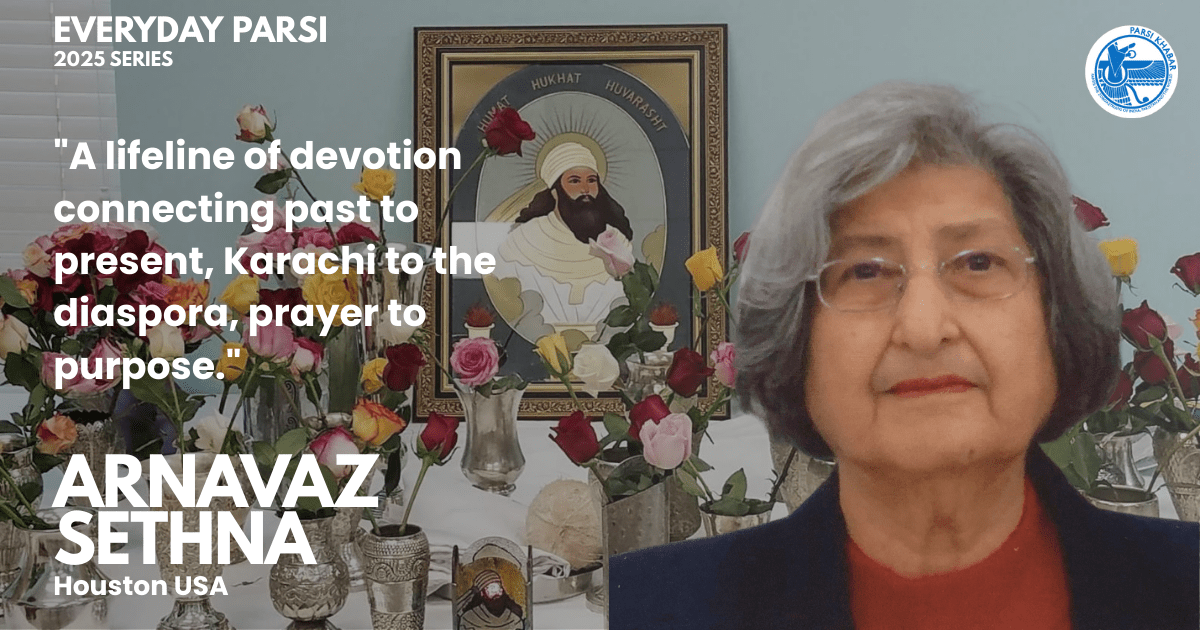
Today is the Vohuxshathra Gatha, the fourth Gatha day of this year’s muktad. And in the 2025 Everyday Parsi series we feature our ninth author Arnavaz Sethna.
My Memories of Muktad in Karachi
Growing up in Karachi in an Athornan family, Muktad days were special to me. Until I was 7 years old, Muktad only meant eating Papri and Malido—somehow none of my cousins and I liked Daroons, which were then fed to any roaming cow that came near the house. Manekji Magol, my mother’s fua, was the Panthaky of Karachi Sadar Agiary and, as such, he had a lot of clientele. Most of the Muktads were held at the house. My aunts would get up around 3:00 a.m. to prepare the many Muktad thalis, filling them with Papri, Malido, Daroon, and one item each of available fruits. The oldest son, Burjor—whom we called Mamaji—was a Navar and helped during Muktad along with some hired Mobeds. After Manekji passed, the Panthaky went to his brother, Jamshedji Magol, who has been mentioned by the late Sarosh Collector.
As I grew older and heard our Dasturji Dhalla’s lectures on various occasions, I came to realize the religious significance of the Muktad prayers. I learned that they are the ten sacred days in Zoroastrianism when it is believed that the souls of our departed loved ones come and visit us. We must welcome them with flowers, fruits, and special prayers.
As was the custom, the families requesting Muktads for their loved ones had to pay for the services of the Mobeds and all the other incidentals that went with the prayers. There were many families who could not afford to pay, and hence they didn’t have the traditional Muktad for their departed loved ones. The solution was to have a Hama Asho Farohar Muktad—prayers to welcome and honor all Fravashis. This would be held in Jehangir Rajkotwalla Hall, set up with marble tables where anyone who wanted could put a vase of flowers at no cost. And thus began the tradition of Ham Bandagi in Karachi.
A program was developed whereby the singing of the fakras would start at 7:00 a.m.—four fakras each day with translation in Gujarati—followed by a 15-minute sermon by Dasturji Dhalla.
All ten days, we woke up early, showered, dressed, and practically ran to Jehangir Baug. We went straight to the Kusti room, did our kusti, picked up the small book of fakras laid out on the table outside the hall, and went in. Copies of the book titled Ham Bandagi matay chunti kadhela Avesta na Fakra were kept there, and I still have one to this day.
Promptly at 7:00 a.m., the congregation would rise, and the fakras to be prayed that day would be announced:
Banuo anay ghrastho, aajay aapray panch, chha, saat anay anth fakrao bhansu.
Mrs. Dubash would come to the podium and sing the fakras in her sweet, melodious voice. First, she would sing a fakra, and then the attendees would repeat it until all the announced fakras were completed. I still get goosebumps thinking of the hall resonating with the sound of the congregation singing. This would be followed by a sermon by Dasturji Dhalla, the High Priest of Pakistan.
After the Ham Bandagi, the priests would perform the communal Muktad prayers, which included Satum (Stum) prayers. And thus, the tradition of ten days of Muktad continued for Hama Asho Farohar. After the passing of Dasturji Dhalla, Ervad Godrej Sidhwa gave the sermons. On a lighter note, as soon as Godrej-ji would come to the podium, we young adults would whisper “aaj no mahro vishai …” because that’s how he would start his sermon. His pet peeve was the 10th day, when every year he would say, “aaj no divas patet no chhay, nahi kay KPI jai nay dance karvano” (“Today is the day of repentance, not to go for dinner and dance at KPI.”).
As the late Sarosh Collector mentioned in his article, he and I discussed continuing this tradition of Ham Bandagi in Houston—and we did, on Navroze day. This was an instant success. In the 1980s and 1990s, we had Ham Bandagi at Rothko Chapel, but with the building of the Zarathushti Center, which has a prayer room, we now have ten days of Muktad ceremonies culminating with the last prayers at Pachhli Raat (just before dawn), followed by the first Havan Geh Boi of Navroze. Later in the evening, we have a Ham Bandagi of the fakras with translation in Gujarati and English. And it continues at our Atash Kadeh to this day.
For ten sacred days, the fakras are chosen—voices raised in solemn cadence, invoking blessings and remembrance. This cherished rite, once anchored in Karachi’s agiaries and prayer halls, flowed through the eloquence of Dasturji Dhalla and the quiet devotion of Godrej Sidhwa, bridging generations across oceans. In Houston today, that same flame endures—rekindled with each Avesta recitation, each remembered name, each whisper of faith. What began as a moment of collective prayer has become a legacy, unbroken and undimmed, a lifeline of devotion connecting past to present, Karachi to the diaspora, prayer to purpose.
Thank you, Arzan, for allowing me to go down memory lane and remember the special days of the Muktad.
About Arnavaz Sethna
Arnavaz Sethna was born in Karachi and was involved in community service from a very young age, helping Manek and Naju Rustomji at the Navroz festival. She served on the Mama School alumni committee for many years. She emigrated to the USA in 1978, moved to Houston, and immediately became a member of ZAH. Later, she served on the Executive Committee as Secretary for several years and was FEZANA Secretary from 1999 to 2003. She is presently the FEZANA Journal Subscription Manager.


