
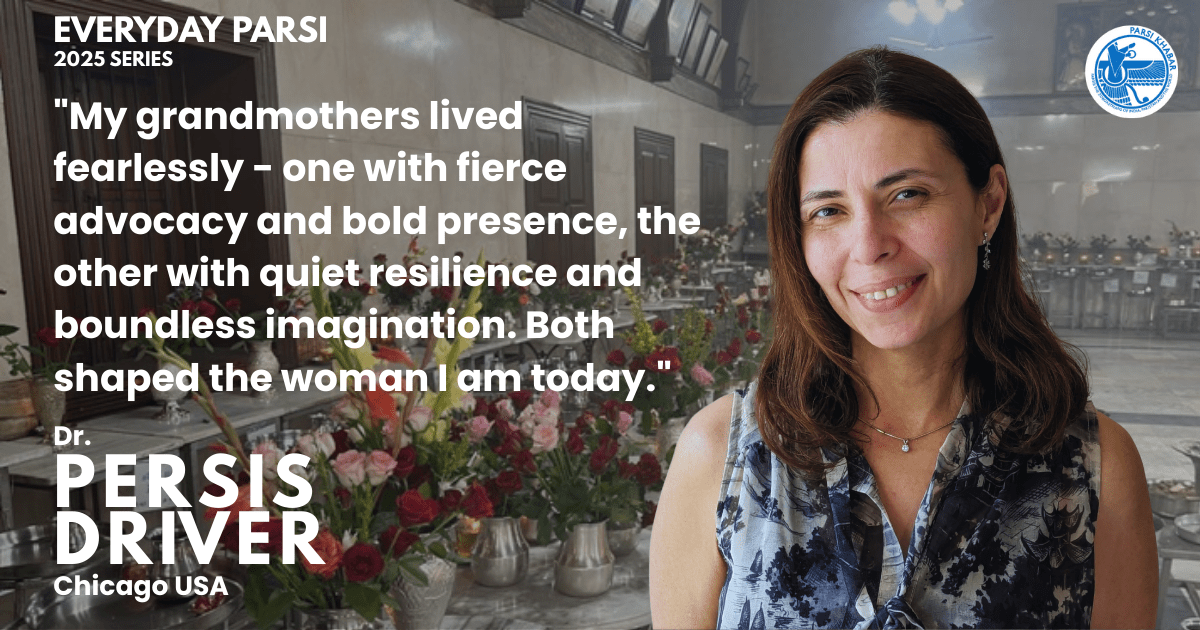
Today is the Vahishtoishti Gatha, the fifth and final Gatha day of this year’s muktad. And in the 2025 Everyday Parsi series we feature our tenth author Dr. Persis Driver.
Flickering Memories of Fearless Women
In my fast-paced, often chaotic life, Muktad days are when time holds still; they are a kind of placeholder on my overwhelmed calendar. They arrive like a whisper, compelling me to pause, reflect, and connect; to experience the beauty of an ethereal presence somewhere between the material and spiritual dualities of our Zoroastrian existence. Although an abstract concept, I find tangible evidence of this liminal space between the living and the departed in the scent of the loban and sukhad, with their wisps spiraling around freshly polished silver vases filled with fragrant gladioli, roses, and jasmine. Each year, childhood nostalgia reminds me of entering the magnificent halls of the Anjuman Atash Behram in Bombay. Here, the early morning air hangs just a little thicker, the symphony of prayers in Dasturjis’ deep baritone voices provides stability in tradition, and the moments of silence command the most alertness. In between sitting and praying and listening, I like to reflect on one simple question: “Who am I?”
One answer to this question lies in the connection I feel to two powerful women whose past shapes my present. The first was my paternal grandmother, Shirin Mamma, who was a formidable presence to reckon with. I never met her, but her legacy lives on in the stories of my father, my uncles, and even passing acquaintances who were her students. She was a high school English teacher, and according to her students and colleagues, the most no-nonsense, dedicated educator who demanded excellence at all costs. She was also a fierce advocate for special needs education at a time of heightened social stigma associated with neurodivergence. And her love story with her high school sweetheart, my grandfather, was often repeated among my Parsi baug neighbors like it belonged in a rom-com. All of 5’1″ with a tiny, graceful physique, she lived life large.
My maternal grandmother, Viloo Mamma, was quite the opposite in demeanor. She had a quiet resilience that made her the unflinching anchor for the next three generations. She was soft-spoken, humble, and incredibly creative. My fondest memories are of sitting by her side, listening to her weave stories from thin air, creating complex characters (with Zoroastrian names) and multidimensional Shahnameh-styled plots. But her imagination was balanced by her astute perception of human nature; family members old and young all reached out to her for compassionate, progressive, and practical advice. Even today, especially during the Muktad days, we cousins reminisce about her measured suggestions and traditional gher na nuskas (home remedies) that continue to guide us daily. But we also find great humor, joy, and love in remembering how she transformed into a shrewd and ruthless competitor during any card game of Rummy or Flush. No one was surprised by her stubborn tenacity, of course, since this unassuming woman was a pioneer of industry and women’s education in her little Gujarat village. Against societal norms and physical pressure, she, along with her older sister, started and managed a flour mill and a school for girls, sometimes at great personal risk.
If the Muktad days are when the veil between the physical and spiritual worlds is lifted, it amuses me to think of the looks on my grandmothers’ faces as they peek through the shroud. I hope they feel proud when, amongst the eight of their female grandchildren, they find successful teachers, business professionals, entrepreneurs, scientists, and social justice advocates. Knowing their competitive nature, I laugh at the thought of their smug smiles watching us flounder in our futile attempts to recreate their traditional recipes of badaam paak and khajur ni ghari. But most of all, I hope they feel gratified in the knowledge that each of us is committed to fearlessly preserving their legacy of faith, family, and community.
About Dr. Persis Driver
Dr. Persis Driver is an Associate Professor of Educational Psychology and Director of the Center for Teaching and Learning at Dominican University in the United States of America and the co-chair of the FEZANA Religion Education Committee (REC). She uses her knowledge of teaching and human development to support a global coalition of over a hundred religion education teachers through an open-resource website for age-appropriate lesson plans. She has compiled a guide on developmentally sound teaching practices for students at diverse ages. She also co-leads the Zoroastrian Intergenerational Oral History (ZIOH) Project that trains and supports middle and high school youth in recording, publishing, and archiving the diverse stories of the global Zoroastrian diaspora.


