

For Shahrukh and Pervien Irani, a film set feels a lot like home. The couple, who stumbled into acting in the early 1980s, share the screen again in Zindagi Phir Bhi Khoobsurat Hai, a Hindi slice-of-life romantic comedy written, directed and produced by Kapil Kaustubh Sharma, who also plays the lead. The title is borrowed from a song in Khatta Meetha, the 1978 film about a Parsi family, and the new film follows a Parsi household too.
The story spans three decades, from the 1990s to 2025, and centres on the Daruwalas, a middle-class family in Grant Road. Shahrukh, 61, plays the patriarch Rustom Daruwala, all bushy eyebrows and generous moustache, with Sushmita Mukherjee as his wife, Mehru. Their sons, Jehangir and Percy, are played by Sharma and Vicky Adnani.
Article by Nisrin Saria | Mumbai Mirror
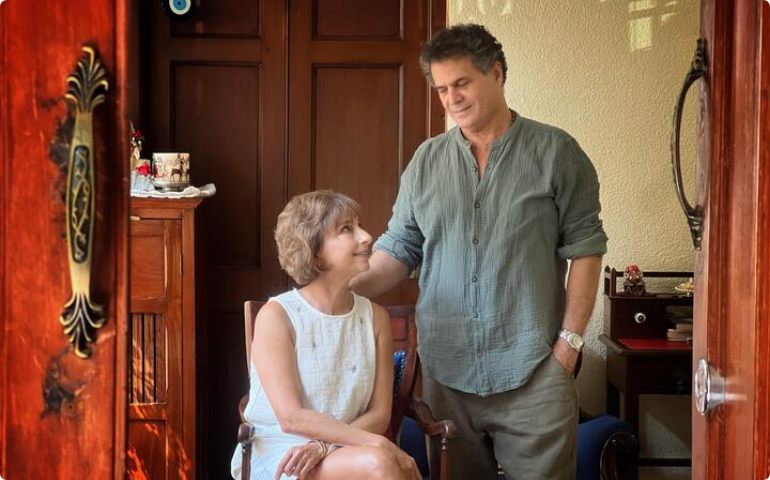
Pervien, 60, plays Firoza, from a far wealthier Parsi family. Her father has made her inheritance conditional on her daughter, Sheenaz (Tara Sharma), marrying a Parsi man, so Firoza sets her sights on Jehangir. He, inevitably, falls for Maria, a Christian girl played by Tanishaa Mukerji. It is a plot many Parsi families will recognise: in a shrinking community, who marries whom is rarely a private matter.
Parsipanu, not pantomime
Shahrukh, grew up in Grant Road, and Pervien’s childhood played out in Colaba’s Cusrow Baug, but the setting hit pretty close to home for both. The production scouted real Parsi homes for months, and shot in his friend’s home in Khetwadi, in Dadar Parsi Colony and in Shahrukh’s own family home in Grant Road, now occupied by his elder sister, Simeen.
Sharma brought the couple in to help with the film’s Parsipanu, its Parsi-ness, especially the way the characters speak. Shahrukh sprinkled Gujarati through the Hindi dialogue, swapping “What are you doing?” for
“Su kare chho?” He also introduced greetings such as “Sebji”, derived from “Sahib ji”, and phrases like “rava devi”, meaning “let it go”, before slipping back into Hindi.
Just as important was knowing what to leave out. “We didn’t want to turn the characters into caricatures. We didn’t want the actors to imitate an exaggerated Parsi accent,” he says. That meant no dagli, the white crossover coat, and no topi in every scene just to signal who’s who. Bollywood has long reduced the community to comic uncles and eccentric aunties. The aim here was people who happen to be Parsi, as different from one another as any family gathered around a Sunday dhansak.
Sitting on the college steps
The couple’s own story began on a flight of steps in Churchgate. Pervien was at KC College and Shahrukh at HR College, and the two would sit on the steps between the campuses. To earn pocket money, they signed up for advertisement shoots. “Like most college students, we were always broke,” Pervien says.
Production teams would round up about 100 young people for background shots, paying Rs 50 and breakfast. Pervien did a few; Shahrukh did many more, graduating to solo campaigns for Kawasaki Bajaj and Thums Up before Lintas spotted him for Raymond’s Park Avenue.
It was another shoot, for Johnson Tiles, that changed Pervien’s life. Director Janak Toprani noticed her and invited her to audition for a play. She had never acted, not even at school, but said yes, and landed a small part in Not Now, Darling, a 1967 farce written by English playwrights John Chapman and Ray Cooney.
Her boyfriend dropped her at rehearsals at Girton High School in Tardeo and waited around to take her home. Soon the theatre crowd had plans for him too.
Toprani needed someone imposing and muscular for a role modelled on Stanley Kowalski, Marlon Brando’s brute in A Streetcar Named Desire, and someone suggested Shahrukh. Between 1983 and 1986, he attended workshops and worked on his voice. In 1986, actor Naseeruddin Shah invited him to audition for The Caine Mutiny Court-Martial. He got the part, and theatre became a serious pursuit.
Three boats, a cab, a train and a rickshaw ride
Pervien, meanwhile, was rising fast in the world of English theatre here. She played the maid Toinette in Molière’s The Imaginary Invalid alongside Naseeruddin Shah, and worked with Pearl and Raell Padamsee, Vikram Kapadia and Dinyar Contractor. Then Sooraj Barjatya saw one of her plays and cast her — then Pervien Dastur — as Seema in Maine Pyar Kiya.
The 1989 hit brought recognition and a flood of offers, few of them appealing. She was about to sign Hum Hain Rahi Pyar Ke when Air India called. Flying had been a childhood dream, along with hairstyling. In 1991, she chose the skies.
Shahrukh was crestfallen. “I really didn’t want her to give up acting at that point,” he says. But Pervien wanted a secure profession she had always pictured for herself. With the airline’s permission, she still took the odd television or film role, but the Maharaja came first.
Shahrukh stuck with the stage, with modelling paying the bills. He remembers once travelling from Alibaug to Prithvi Theatre in Juhu — jumping across three boats, and taking a cab, a train and a rickshaw during the commute — to make it for a performance, for which he was paid Rs 35. He took on production, light design and backstage work to keep going. “Once I got into acting, I realised it was what I wanted to do. I never looked back. I didn’t want to do anything else,” he says.
Life at the baug
Marriage in 1992, two daughters and the rhythms of Parsi family life took over. The Iranis made their home in Cusrow Baug, the Colaba colony where Pervien grew up, a world of shared courtyards, Saturday-night music and neighbours who know your business. As Shahrukh once said, whatever you do there will probably be discussed at the gate.
Shahrukh kept a foot in the business through occasional theatre, advertisements and voice-overs. Pervien flew, and for nearly a decade alongside flying, worked as a hairstylist and make-up artist. Only once their daughters had grown up and moved to Dublin for their master’s degrees did the couple return to screen work in earnest.
That return came through Sharma’s murder-mystery series Margaon: The Closed File, centred on a Catholic family. Pervien took his call while out on a walk and briefly mistook him for comedian Kapil Sharma, before realising it was a different Kapil. She signed on, and their 25-year-old daughter, Genevieve, was also cast as Rachel, the niece of Rose Briganza (Kitu Gidwani), after the director spotted her on Pervien’s Instagram.
The shoot was at a palace in Chhota Udaipur, near Vadodara. Pervien asked if Shahrukh could come along as chaperone, and the makers agreed. Three or four days before they left, Sharma called again: the actor playing the love interest of Zeenat Aman’s character had dropped out. Would Shahrukh step in? He did, and the chaperone became Thomas. Now, four decades after those college steps, the Iranis are working side by side again. They don’t interfere with each other’s performances, they say, but offer feedback when asked. On a film about a Parsi family navigating love, money and the question of who marries whom, they bring something no script can: a lifetime of living it.