
A historic portrait of Dadabhai Naoroji — the Parsi nationalist leader who became Britain’s first Asian MP — is set to go on public display at the National Portrait Gallery in London from September 2nd. For more than 70 years, the painting hung at the India Club on the Strand, until the restaurant lost its long fight to extend its lease and closed for good in 2023.
The portrait, painted by artist Sorab M Pithawalla and signed and dated Bombay, 1946, was sent from what was then Bombay to London to hang in the India Club, a short walk from the National Portrait Gallery itself. When the club’s manager, Yadgar Marker, was effectively ousted by freeholders Marston Properties, who wanted to convert the building into a hotel, he and his daughter Phiroza announced its closure in the summer of 2023 in terms that read almost like an obituary: “It is with a very heavy heart that we announce the closure of the India Club, with our last day open to the public on 17th September.” Historian Kusoom Vadgama, who had turned to the club “in search of Indian faces” after arriving in London from Kenya in 1953, called its closure “like a death sentence for the Indian community… It’s like a murder.”
A portrait saved, and a call that changed its fate
Rather than let Naoroji’s portrait disappear along with the club’s other fixtures and fittings, Marker set it aside. “I telephoned the National Portrait Gallery and told them I have this portrait,” he told Eastern Eye. “They were very interested. I said I would give it to them on loan.” The gallery’s Senior Curator of 19th-Century Collections, Sarah Moulden, inspected the painting in Marker’s apartment and was, in his words, “very excited.” “The National Portrait Gallery were extremely happy to have been approached, as until now they have had a very small sketch of Dadabhai,” Marker said. “We are more than delighted that the portrait has found a new home where Dadabhai Naoroji’s achievements will be noticed and much admired.”
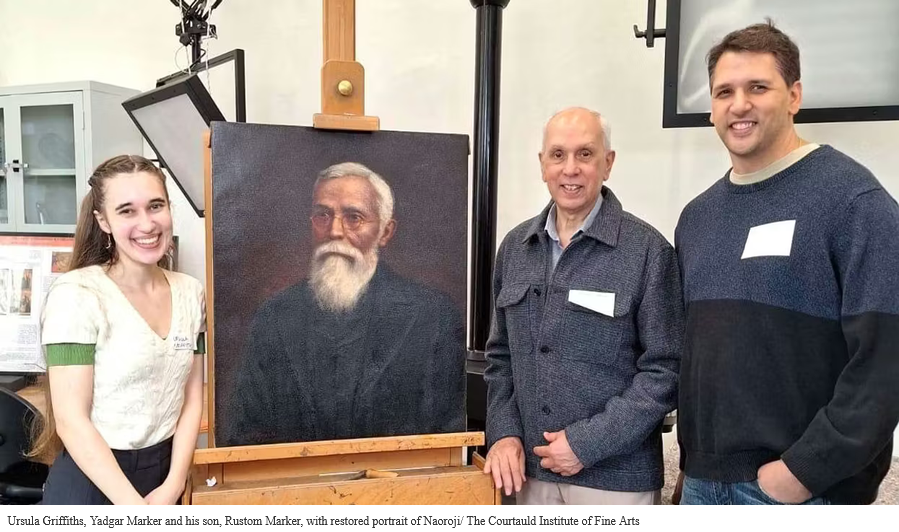
The painting — oil on canvas, 756 x 615 x 24 mm — had absorbed decades of kitchen smoke and the aroma of bhuna lamb, prawn curry and masala dosa from hanging just inside the restaurant’s entrance, and needed careful attention. It underwent restoration through the Courtauld Institute of Art’s “Painting Pairs” programme, which pairs art history and curating students with conservation students to jointly research and treat a chosen work. The 2024–25 project team, MA History of Art student Benjamin Singer and conservation student Ursula Griffiths, examined the painting’s construction in detail, from its commercially primed linen canvas to zinc-stearate additives typical of early-to-mid-20th-century tube paints, and traced Pithawalla’s technique to his training under John Griffiths at the Sir Jamshedjee Jeejeebhoy School of Art. The National Portrait Gallery covered the full cost of the restoration. Marker also revealed that a thief once tried to steal the Naoroji portrait from the India Club, removing the canvas from its frame before being stopped — a fate that a companion portrait of Shapurji Saklatvala, which also hung at the club, was not spared.
The Marker family, of Parsi heritage like Naoroji himself, has loaned the restored portrait to the National Portrait Gallery for an initial three-year period, expected to be renewed. It will hang in Room 23, the Empire and Resistance Gallery.
“Not about size, but about reliability” — a curator’s tribute
“We are delighted to be showing this portrait of Dadabhai Naoroji, who was such a remarkable figure in British political life in the Victorian and Edwardian eras,” said Sarah Moulden. “As one of the first Asian MPs in Britain — he was, in fact, the first — and a leading critic of colonial rule in India, he helped shape debates about empire and self-government. It’s wonderful to bring Naoroji back into view through this portrait, and to share the story of a man whose life reflects the close connections between Britain and the wider world.”
The man Lord Salisbury said Britain wasn’t ready for
Known as the “Grand Old Man of India,” Naoroji was born in Mumbai on September 4, 1825, to a Parsi family, and first travelled to England in 1855 for business, opening Cama & Co in the City of London with Seth Muncherji Hormusji Cama and Khurshedji Rustomji Cama — the first Indian trading firm established in Britain. He went on to become the first Indian appointed to an academic position in colonial India, as Professor of Mathematics and Natural Philosophy at Elphinstone College, Bombay, and later the first Indian Professor of Gujarati at University College London. In 1861, with Seth Muncherji, he co-founded the Zoroastrian Trust Funds of Europe (ZTFE), today the oldest Indian or Asian faith-based voluntary organisation in Britain, serving as its founder trustee and president until 1907.
Naoroji first stood for Parliament in 1886 as the Liberal candidate for Holborn and lost. Prime Minister Lord Salisbury dismissed the defeat as proof that British voters were not yet ready to elect a “black man” to Parliament, adding that the House of Commons was “a machine too peculiar and too delicate to be managed by any but those who have been born within these isles.” Naoroji did not back down, and in July 1892 he was elected MP for Finsbury Central, defeating the Tory candidate Frederick Penton by 2,961 votes to 2,956 — a majority of just five — to become Britain’s first Asian MP. His election agent on that campaign was a young law student named Muhammad Ali Jinnah, then still championing Hindu-Muslim unity, decades before he would go on to found Pakistan.
Naoroji was followed into Parliament by two more Parsi MPs: Sir Mancherjee Bhownaggree, Conservative MP for Bethnal Green North-East from 1895 to 1906, and Shapurji Saklatvala, Communist MP (endorsed by Labour) for Battersea North from 1922–23 and again from 1924–29. All three were Zoroastrians. A study accompanying the portrait’s restoration noted that Bhownaggree and Saklatvala appear, in photographs and portraits alike, to have adopted a similar style of dress to Naoroji — a deliberate blending of British political convention with their own heritage.
Naoroji returned to India in 1907 and died in Mumbai on June 30, 1917, at the age of 91. Mahatma Gandhi, who regarded him as a mentor, wrote to him from South Africa in 1894: “The Indians look up to you as children to the father. Such is really the feeling here.”
A tribute from a fellow Parsi peer
Lord Karan Bilimoria — who in 2006 became the first Zoroastrian Parsi appointed to the House of Lords — called the portrait’s restoration and display “a profoundly important moment.” He recalled being taken to the India Club as an 11-year-old by his father, Lieutenant General Faridoon Bilimoria, and later being proud that the club was among the first establishments to stock Cobra Beer, the brand he founded. “It is fitting that Dadabhai Naoroji should now be represented in one of Britain’s foremost national institutions, the National Portrait Gallery,” Bilimoria said. “His story belongs at the heart of British history and reflects the longstanding contribution of British Asians to this country.” He added that he had read Naoroji’s maiden speech before delivering his own, and had paid tribute to him in it: “He has been an enduring inspiration to Indians over the years.” Last year, Bilimoria hosted an event in Parliament marking the 200th anniversary of Naoroji’s birth.
The Zoroastrian community’s own tribute
Malcolm Deboo, president of the Zoroastrian Trust Funds of Europe — the organisation Naoroji himself co-founded in 1861 — welcomed the news warmly. “This is wonderful news,” he said, adding that the trust and the wider Zoroastrian community “are delighted and will be visiting the National Portrait Gallery to view the restored portrait of Dadabhai Naoroji,” and expressing gratitude to Yadgar Marker for loaning the portrait and to the National Portrait Gallery for restoring and exhibiting it. Deboo has previously spoken at length on Naoroji’s many achievements, describing him as “a Philomath who had varied interests” — politician, Zoroastrian priest, interfaith advocate, educator who promoted girls’ education when it was unfashionable, trader and investor, all in one long and remarkable life.
The India Club building on the Strand stands boarded up today, its future as a hotel still unrealised. But through this portrait, and the recognition it has now found at one of Britain’s great national institutions, a part of its history — and Dadabhai Naoroji’s own extraordinary story — lives on in full public view.