

A Cambridge spin-out co-founded by a Parsi physicist has won a European drug discovery prize for its work on recurring bacterial infections.
BioTryp Therapeutics, a University of Cambridge spin-out co-founded by Dr. Jehangir Cama, has won the 2026 ELRIG Drug Discovery Innovation Award. The company was chosen from 42 start-ups exhibiting in the Breakthrough Zone at ELRIG Drug Discovery 2026, held on 14 and 15 October at ExCeL London. Jehangir, BioTryp’s co-founder and Chief Commercial Officer, told Jam-e-Jamshed the win was “a wonderful achievement for our team.”
The award
ELRIG is a not-for-profit, volunteer-led organisation that runs free conferences for the drug discovery and life sciences community. Its Drug Discovery conference in London is one of the largest such gatherings in Europe. The Innovation Award, sponsored this year by Mathys & Squire, recognises young companies whose ideas could change how medicines are discovered or address a major clinical problem. Shortlisted companies presented their work on the main stage on the first day of the conference.
Speaking to Jam-e-Jamshed, Jehangir said the award put BioTryp’s technology in front of exactly the right audience and gave the team outside validation for years of work.
What BioTryp is working on
Many bacteria do not live as lone cells. They cluster together and build a protective layer around themselves called a biofilm. Inside it, they are shielded from antibiotics and from the body’s immune system, so an infection can survive a full course of treatment and come back. The University of Cambridge’s commercialisation office estimates that about three quarters of bacterial infections involve biofilms.
BioTryp has developed small molecules that stop bacteria from forming biofilms in the first place. The molecules do not kill bacteria, so the company expects them not to drive antibiotic resistance. The plan is to give them alongside existing antibiotics so the antibiotic can clear the infection, and later to use them on their own to keep infections from returning.
The first target is recurrent urinary tract infections (UTIs). UTIs affect an estimated 400 million people a year worldwide, and E. coli, the bacterium BioTryp has tested its compounds against, causes most of them. Today, many patients with repeat UTIs are put on low-dose antibiotics for months at a time. In his interview, Jehangir pointed out that this long-term use feeds antibiotic resistance and disturbs the body’s helpful gut bacteria. He also noted that no comparable anti-biofilm treatment is on the market.
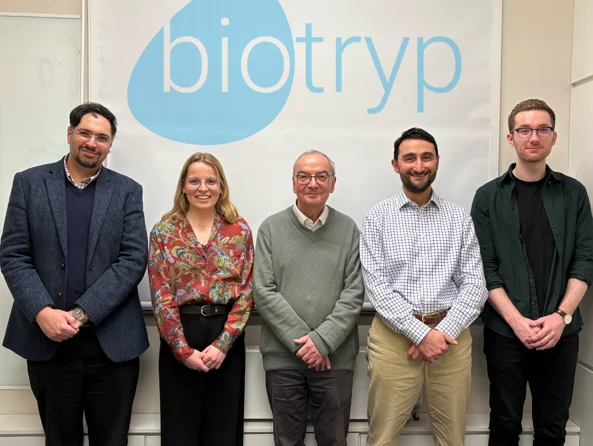
Dr Jehangir Cama (Commercial Director), Dr Juliette Nourry (Research Scientist), Dr David Summers (Scientific Director), Dr Ashraf Zarkan (CEO), and Mr Kieran Abbott (Research Scientist).
From a Cambridge lab to a company
The science began in the Department of Genetics at Cambridge, in the laboratory of Dr. David Summers, who studied how a small ring of bacterial DNA controls the growth and division of its host cell through chemical signals. About ten years ago, Dr. Ashraf Zarkan joined the group and brought a pharmacy background to the work. Jehangir collaborated with the department on bacterial signalling during his own research, and the three formally launched BioTryp in early 2024. Dr. Zarkan is CEO and Dr. Summers is Chief Scientific Officer, with research scientists Dr. Juliette Nourry and Kieran Abbott completing the team.
Since then the company has picked up several prizes, grants and partners:
- January 2024: Hellings Prize at the Trinity Bradfield Prize.
- August 2024: £300,000 in pre-seed funding from QUBIS Innovation Fund, Cambridge Enterprise Ventures and Parkwalk Advisors, after the inaugural Founders at the University of Cambridge accelerator.
- November 2024: One of three start-up winners of the Santander X Global Challenge in healthcare innovation.
- January 2025: Angel Prize at the Trinity Bradfield Prize, shared with Cambridge Nucleomics.
- November 2025: A UK–Canada research project with Intellisyn Pharma, backed by Innovate UK and Canada’s NRC IRAP, to move BioTryp’s compounds towards lead candidates.
- April 2026: Named in the Business Weekly Killer50 list of Cambridge companies.
- October 2026: ELRIG Drug Discovery Innovation Award.
Jehangir told Jam-e-Jamshed there is still a lot of work to do before clinical trials. The team has finished the “hit expansion” stage of medicinal chemistry and is now raising money for “lead optimisation”, where chemists refine the best compounds so they are safe for patients and move through the body correctly. In a February 2026 profile by Mewburn Ellis, the company said a first human trial could come around 2029. He credited the Cambridge life sciences network, grant funders and investors for getting the company this far, and said finding the right scientific and commercial partners has been one of the hardest parts of the work.
Jehangir’s path: Delhi to Cambridge
Jehangir took his BSc in Physics at St. Stephen’s College, University of Delhi. In 2008 he received a Goldman Sachs Global Leader Award, which brought him to the Global Leadership Institute in New York. A Jawaharlal Nehru Memorial Trust Cambridge Scholarship then took him to Trinity College, Cambridge, where he read Parts II and III of the Natural Sciences Tripos in Physics.
He stayed at Trinity for his PhD, working at the Cavendish Laboratory under Prof. Ulrich Keyser. His doctoral research looked at how antibiotics cross biological membranes, using lab-built model membranes and tiny fluid channels (microfluidics) to measure the process. He continued that work as a postdoctoral researcher at the Cavendish and was a Research Fellow at Clare Hall, Cambridge, from 2016 to 2019.
From 2019 to 2022 he was an Industry Research Fellow at the Living Systems Institute, University of Exeter. Alongside his research there, he built partnerships between the university and industry, including leading a strategic partnership with the Medicines Discovery Catapult, and worked on the economics of developing new antibiotics. He then returned to Cambridge, where he is now an Official Fellow and Tutor at Clare Hall and is affiliated with the Department of Materials Science and Metallurgy.
A second venture: ArtioSense
With Prof. Sohini Kar-Narayan, orthopaedic surgeon Mr. Vikas Khanduja and Dr. Alex Samoshkin, Jehangir also co-founded ArtioSense, a medical technology spin-out that is developing flexible microfluidic force sensors to help surgeons during joint replacement surgery. He leads its commercialisation. ArtioSense won the Armourers and Brasiers Venture Prize in 2022, and the underlying research was published in Materials & Design the same year.
Beyond the lab
Jehangir is a pianist and has performed sonatas by Liszt and Chopin in the Chapel of Trinity College, Cambridge. He is also a keen golfer and a member of the newly formed Clare Hall Golf Society.
Parsi enterprise in the lab
Jehangir has said he wants to bring the spirit of Parsi entrepreneurship to scientific research, to the benefit of science and humanity.
Parsi Khabar congratulates Jehangir and the whole BioTryp team, and we look forward to following the company as it moves towards the clinic.
This article draws on an interview with Dr. Jehangir Cama by Freny Daruwalla, published in Jam-e-Jamshed Weekly on 15 November 2026 (page 11), along with public information from the University of Cambridge, Clare Hall, the University of Exeter, ELRIG and BioTryp Therapeutics.
Sources
- BioTryp Therapeutics: News and updates
- Clare Hall: Dr Jehangir Cama
- Clare Hall: BioTryp secures pre-seed funding (August 2024)
- University of Exeter: Dr Jehangir Cama
- Cambridge Enterprise: BioTryp case study
- Mewburn Ellis: BioTryp’s radical new treatment for bacterial infection
- ELRIG Innovation Award framework
- Mathys & Squire: Sponsoring the ELRIG Innovation Award
- X-Chem: BioTryp and Intellisyn Pharma collaboration