
When Nariman Karkaria, an Indian-Parsi soldier who fought in World War I, departed from Bombay on October 24, 1923 for a trip to Iran, the country was in the throes of a regime change. Before Karkaria could reach Iran, Ahmad Shah Qajar, the Shah of Iran, went into exile on November 10, 1923.
Article by Murali Ranganathan | The WIRE
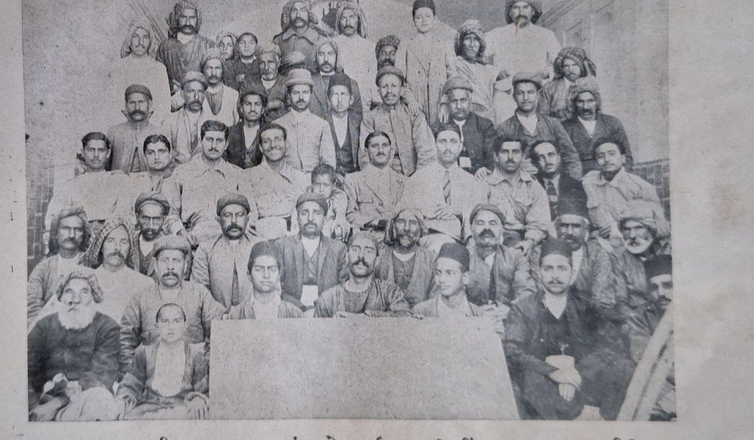
Nariman Karkaria at Yazd. Photo: Author provided.
During the First World War, Britain and Russia jointly fought the forces of the Ottoman Empire on Iranian soil. After the war, the Russian (who were now the Soviets) and British armies became colonial occupiers of Iran, but adversaries, both vying for a share of Iran’s newly discovered petroleum riches besides its other resources. When the occupation armies finally agreed to withdraw from a politically weakened Iran in early 1921, it encouraged Reza Khan, a brigadier who commanded the Persian Cossack Brigade, to march into Tehran and seize power to become the de facto ruler. Before departing from Iran, Ahmad Shah Qajar acknowledged the transfer of power by appointing Reza Khan as the prime minister of Iran.
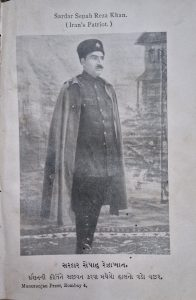
Sardar Sepah Reza Khan. Photo: Author provided.
Though Iran was no longer a mysterious land to the Parsis of India, it was still a potentially dangerous place for a Zoroastrian. Karkaria would have imagined himself as walking in the footsteps of Manekji Limji Hataria (1813–1890) who was sent from Mumbai to Iran in 1854 by the Society for the Amelioration of the Condition of Zoroastrians in Persia. Hataria returned to Mumbai in 1863 and delivered a series of lectures about his experiences that he later compiled into a book, Iran Deshni Safarna Saarno Report (1865). He reported that centuries of persecution and dwindling numbers had left the Iranian Zoroastrians in a precarious condition. Describing the dangerous conditions of travel in Iran, Hataria noted that, “During my travels, I always secured the necessary government permits and sought assistance from local officials in every city. However, at every place, I had to ensure that my men were armed and always on guard. To hide my identity, I changed my costume often so that I would not be identified by any external markers. Even though my travel expenses were much more than I had budgeted for, whenever I encountered bandits and brigands, I had to abandon my goods to save my life. And I was often betrayed by those co-religionists whom I trusted to help me. Suffice to say that wherever I went during my arduous travels in Iran, my life was in danger.”
Dorothy De Warzée, in her book, Peeps into Persia (1913), noted that, in the 1880s, Zoroastrians “were only allowed to ride on donkeys, horses and mules being considered too good for them.” To readily distinguish them from Muslims, Zoroastrians were forbidden from wearing white garments; instead, as Ella Sykes, remarked in Through Persia on a Side-saddle (1898), they were “attired in coats and turbans of a hideous shade of mustard brown.” Violence and harassment were commonplace and fatalities were not unknown. In the 70 years since 1854, the situation of the Iranian Zoroastrians had slightly improved. The jizya, a tax levied on non-Muslims, had been abolished and the laws under which they were discriminated against had been repealed. However, the infrastructure for travel in Iran had hardly changed since Hataria’s time.
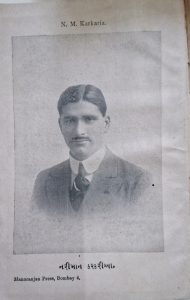
Nariman Karkaria. Photo: Author provided.
The principal cities of the mountainous country of Iran were connected by narrow trails and the primary mode of transport was still the donkey or mule. Pack animals were used for transporting goods over long distances. After the First World War, surplus military vehicles began to be used as taxis on a few routes from the early twenties. However, they frequently broke down and were unreliable. The old caravanserais were still in use but they were dilapidated and dirty. The British had set up a telegraph system and, on some routes, the telegraph offices doubled up as rest houses. The roads were infested with brigands but the new regime had begun hunting them down.
It was under such tumultuous circumstances that Karkaria intended to undertake a visit to Iran. Nariman Karkaria (1894–1949), though still in his 20s, was no ordinary traveller. A decade earlier, he had travelled from Peking to London via the Trans-Siberian Railway to volunteer with the British Army. Karkaria was among the select few soldiers who saw action on three fronts during the First World War and survived to tell the tale. And what a raconteur he turned out to be! Written in Gujarati, then the primary language of the Parsis, Karkaria’s war memoir, titled Rangbhoomi par Rakhad, was published in 1922. It made his reputation among the Parsis not just as a traveller but also as a travel writer.
When the Parsis of Mumbai sought to fund the trip of a person who would spend a year exploring Iran, Karkaria was the obvious choice. He would report on the living conditions of the Iranian Zoroastrian community and suggest steps which the Parsis of Mumbai could take for their amelioration. He would also examine the economic opportunities which the Parsis of India could exploit under the new, seemingly liberalised, regime. After spending a year in Iran, Karkaria returned to Mumbai and compiled his notes and impressions into a book titled Iranbhoomi par Rakhad or Wanderings in Iran. Published in 1925, the 600-page tome is a unique snapshot of Iran on the cusp of change. Though structured as a travelogue and guidebook for other Parsis who might want to visit Iran, it was much more than that.
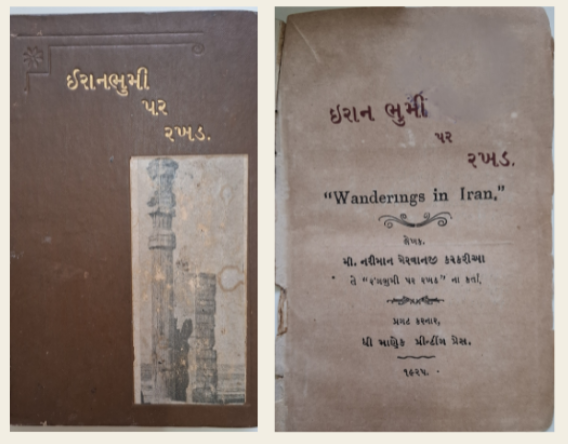
Book cover and title page. Photo: Author provided.
To prepare for the trip, Nariman Karkaria worked his way through an entire bookshelf of books related to Iran. Not only did he need to improve on his knowledge of pre-Islamic Persian history, he also had to glean practical advice on travel within Iran. Besides Gujarati books, the list of authors he consulted included “Professor Jackson, Lord Curzon’s two volumes, General Sykes’ two volumes as well as his Ten Thousand Miles in Persia, Sir Rawlinson, Sir Porter, Sir William Ouseley, Professor Browne, Mr. Neligan’s Hints for Persia, Mr. Shuster Morgan and Mr. Morier.” Even in the 1920s, visitors to Iran generally carried large supplies of food and camping equipment because of the lack of lodging and boarding facilities. However, Karkaria intended to travel light.
“After a lot of thought, I decided to travel with only a kit bag. Nothing fancy, cost me a rupee. If no porters were available, I could just haul it myself and set off. No fuss about the clothes either. Two woollen undershirts and four white shirts besides, a pair of khaki shorts, khaki breeches (they proved to be very useful), thermal underwear, two wool day trousers, and, a khaki overcoat. A pair of heavy military boots which could serve as a hammer in case you wanted to pound someone’s head. A pair of skintight boots and a dark blue suit that would double up as an evening dress if the occasion arose. A dozen sadras and six pyjamas. Three pairs of military socks and another three pairs of slightly more stylish socks. A water bottle (extremely useful at all times) and a haversack for miscellaneous stuff. It could also be used during day trips to explore ruins for carrying food. A rough sporting suit was always needed and a sola topi was particularly useful while travelling during the day. For bedding, two military blankets, an Indian quilt and a pillow or just a pillowcase in which you could stuff clothes. Plus a waterproof cape is most useful against the cold, wind and sandstorms. Don’t forget to carry quinine and other medicines that one needs to dispense at every village. And finally, a sense of humour to dispel all your problems.”
Karkaria also had a camera and a revolver. He used the former to good effect to take images to illustrate his book while the latter turned out to be unnecessary, though he once shot a deer on the request of his muleteer.
Nariman Karkaria intended to travel on a shoestring budget but could wrangle a free first-class passage to Iran’s main port, Bushire, on board the SS Shushtar since its Persian owner, Aga Mohammad Jafar Shushtari, was keen to assist Parsis visiting their ‘motherland’. Once he landed in Bushire in November 1923, Karkaria opted for slow travel. He travelled everywhere on either mule or donkey and was generally part of a caravan transporting goods. Could Karkaria converse in Farsi? Possibly, but he never mentions it.
From Bushire, Karkaria went to Shiraz. And then further east to Yazd and Kerman, the two Iranian cities with significant Zoroastrian populations. He then travelled to Tehran via Isfahan. From Tehran, he visited Hamedan and Kermanshah before crossing over to Iraq. He stayed for a few weeks, sometimes as long as two months, in every city. Wherever he went, he sought out Zoroastrians, met local officials and collected administrative reports, inspected military establishments and fraternised with officers, explored nearby ancient ruins, and studied the local economy.
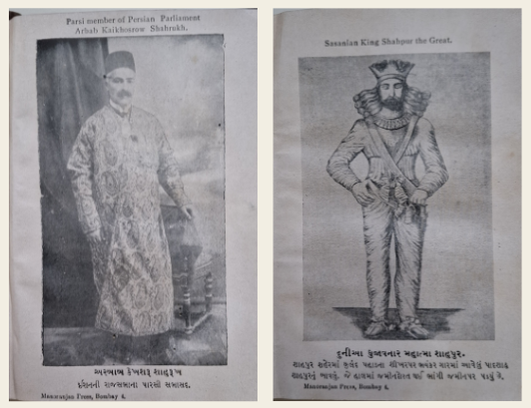
Kaikhosrow Shahrukh (L)Sassanian King Shapur (R). Photo: Author provided.
It was only after European travellers of the early 19th century wrote about the ruins of the ancient Achaemenid Empire (550–330 BCE) and deciphered the cuneiform inscriptions that the Parsis of India could claim them as part of their heritage. The few Parsi visitors who visited Iran sought to visit these archaeological sites such as Persepolis and Tak-e-Bostan. Many were deterred by the fact that they were located in out-of-the-way places, accessible only after long and arduous climbs. Karkaria was, however, cast in a different mould. The first ancient site that he visited was the cave, located a few days ride from Bushire, inside which was a colossal statue of Shapur I, the second Shah of the Sassanian empire from 240–270. Karkaria had to climb a steep hillside with a local guide for a few hours before he could get to the entrance of the cave. Claiming to be the first Zoroastrian to see this remarkable statue in many centuries, Karkaria mourned its neglected state as it had collapsed. Karkaria’s account of his visit to yet another cave near Hamedan to examine a few stone sarcophagi associated with the Parthian Empire illustrates the risks he took during the journey:
“After an unrelenting climb of five hours, we finally reached the front of the cave. My heart sank when I noticed that the cave had no entrance. Instead, a very small doorway had been cut into the rock through which a thin man could slide inside after lying flat on the ground. It promised to be a scary experience. However, inspired by my guide’s bravado, I decided to go ahead after muttering a few prayers. Holding candles in our hands, we both crawled forward while our knees bumped and scraped against the stones on the ground. We had barely advanced a dozen feet and turned leftwards when we heard a blood-curdling screech. It was a little fox dashing towards the entrance when it noticed us. As it was pitch dark, I could barely make out what is was. To add insult to injury, my candle slipped out of my hands and was extinguished. I was frightened out of my wits. The space was so cramped that we could neither retreat nor turn this way or that. Luckily we were just short of the main cave and the poor fox squeezed past us once we were able to stand up. “
But it was not all fun and games for Karkaria. The book is peppered with observations on the local economy and elaborate calculations on what the cost of goods imported from India would be in Tehran and other Iranian cities. After studying “the stormy business situation in Iran in minute detail,” Karkaria was pessimistic about Parsi entrepreneurship in Iran. There was little likelihood of them obtaining lucrative contracts “in railways and oilfields and precious metals” or procuring “senior positions in the new Iranian government.”
Nariman Karkaria, a lapsed priest himself, was also concerned about the state of Zoroastrian rituals and practices in Iran. He had already noticed that “a wind of Bahaʿism seems to be blowing in all corners of the land, stronger than is generally acknowledged or known.” He considered Baha’ism to be the biggest threat to the Zoroastrian religion in Iran as its adherents “were unable to understand the Zoroastrian religion and neither was there anyone in Yazd who could properly explain its precepts. However, they are better able to understand the edicts of Hazrat Bahaullah.” Karkaria recommended that Zoroastrian missionaries be dispatched from India to Iran to stop this drift.
Armed with letters of introduction to British consuls and prominent Iranian Zoroastrians, Karkaria could easily gain access to officials in the Iranian government. He was also able to meet Reza Khan, who then bore the title Sardar Sepah (Commander-in-Chief). According to Karkaria, “Iran, which had been floundering mid-sea like a ship without a steersman for the many years past, has, to its good fortune, discovered in the person of Sardar Sepah Reza Khan, a captain who has stepped forward to dedicate his life to the country.” He had pledged to treat all his subjects equally without discriminating on the basis of religion.
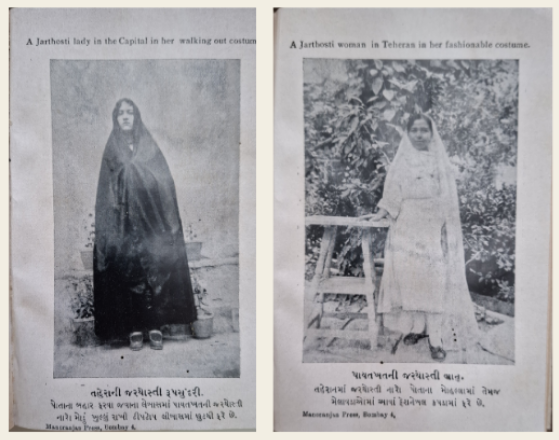
Zoroastrian women. Photo: Author provided.
Though Reza Khan “was deeply regretful of the miserable condition of the Zoroastrians in Iran,” he told Karkaria that he was constrained from helping them as “their lack of education prevented him from appointing them to any important position in the new dispensation.” He, however, courted the Parsis of India and urged them to return to their ‘motherland’ and invest their capital for its progress. The Parsis were equally enthused by the Reza Khan’s invitation and hoped that the new regime would open up more options for them as they tried to navigate political uncertainty in India. By December 1925, the Qajar dynasty was formally extinguished and the Pahlavi dynasty was founded by Reza Khan, who assumed the name Reza Shah Pahlavi.
To neutralise British and Russian influence in Iran, Reza Shah turned to Germany and other European countries for trade and investment during the inter-war years. In yet another instance of regime change in Iran orchestrated by foreign powers, Reza Shah, whose policies were seen as inimical to Anglo-Soviet war interests, was forced to abdicate in 1941 in favour of his son. The Parsi honeymoon with Pahlavi Iran had however ended much earlier.
In the heady first decade of Pahlavi rule, nearly a dozen books on Iran were published by Parsis who visited the country. Nariman Karkaria’s Iranbhoomi par Rakhad was hardly unique but he claimed that his book, based on direct observation and many months of travel, was the most comprehensive and the most authentic one. However, as Iran gradually slipped from its exalted status in Parsi geography, Karkaria’s book and others of its ilk were rendered irrelevant and were soon forgotten. Karkaria later joined the Indian Army and was a military instructor during the Second World War. After a few more regime changes, engineered by foreign hands, during the twentieth century, the Islamic Republic of Iran was founded in 1979.
Murali Ranganathan is a historian and translator. His translations include The First World War Adventures of Nariman Karkaria: A Memoir.