

In a modest Parsi household in Andheri, where the pagri-clad patriarch passed away last month, there are no portraits of the departed — only ones painted by him.
Propped on a narrow cot is a six-decades-old painting of a young girl named Firooza, alongside two landscapes evoking Google Maps: Naval Jijina’s signature aerial views from the 1960s, conjuring the sensation of flying.
By Sharmila Ganesan / TNN
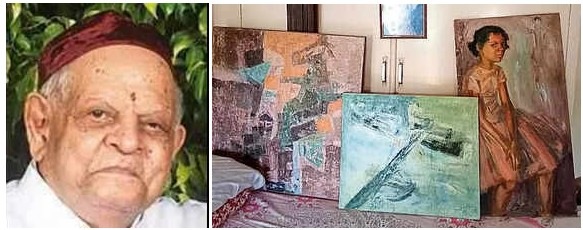
“He had never been inside a plane though,” says his wife, Gool. “Rather, he was on a higher plane than ordinary…”
Jijina — a Zoroastrian priest and reclusive post-war modernist — died on April 22 at the age of 96, leaving behind a legacy of vibrant canvases that stretch from Andheri to America. A contemporary of Raza and Gaitonde, the Sir JJ School of Art alumnus produced works now housed in homes and institutions worldwide, from the Singapore Parsi Community Hall to Mumbai’s Godavra fire temple in Fort, where he once served as a priest.
“His life was full of hard knocks,” Gool says of her husband, who was born in 1929 and raised in a Surat orphanage after his mother died when he was a toddler. Though he trained to be a priest, his soul was drawn to colour.
“For seven and a half years, they never raised my salary beyond ₹45,” he once said of his time at a Mumbai agiary.
Eventually, he followed his boyhood passion for sketching, studying at Nutan Kala Niketan in Girgaum and later at Sir JJ School of Art, where he faced initial rejection.
“They said there was no spark,” he recalled in an interview.
Under abstractionist Shankar Palshikar, however, he found it.
Jijina sketched commuters at CSMT’s outstation platforms, while lessons on composition from the hard-to-please Palshikar turned his tram tickets into miniature canvases. As a tabla player, Jijina found rhythm in hues. Inspired by artist Paul Klee’s words — “Colour is optimism” — he learned to blend even the most contrasting shades, says Gool, who met her husband through music.
Keki, her sitar teacher and Jijina’s cousin and tabla teacher, introduced them. Once married, Gool supported him through the precarious 1970s, when he freelanced for textile traders in Bombay’s Mulji Jetha Market.
Trusting a boss who promised better pay and a house in Delhi, the couple moved to the capital — only to discover they had been duped.
“There was no house,” says Gool.
The loss of a child soon after deepened their sorrow.
Jijina refused a factory posting in Faridabad. Having booked a one-man show at Jehangir Art Gallery in 1971, he suffered a breakdown as he had no home to return to in Bombay.
“Eventually, we stayed with my parents until we got this place,” says Gool, pointing at the floor.
Seated in his favourite semicircular wooden chair, the 92-year-old recalls the time her beloved husband brushed his teeth with soap to save money for paint.
“That’s probably why he had dentures by his forties,” she quips to her nieces in Gujarati.
By then, Jijina was part of the rare circle of city abstractionists reshaping Indian modernism. Deeply spiritual, he often painted figures from Hindu and Zoroastrian mythology with a prayer on his lips.
“While drawing portraits, he talked to the canvas like it was a person,” says Gool about Jijina, who especially cherished his portrait of Einstein.
A turning point came when he was commissioned by a businessman named P. B. Warden to illustrate the life of Prophet Zarathushtra. The works were shipped to London and later auctioned in the United States, without his knowledge.
“He never got his dues,” says Gool.
Her niece is not surprised: “He wasn’t street-smart. He felt disillusioned with the art world.”
After losing two mill jobs due to retrenchment, Jijina survived on a vada pav a day, painting and drumming even in despair. When his beloved painting knife broke, “he kissed it and wept,” says Gool.
In 1976, colour returned to his life when he joined the Photographic Society of India. Under mentor Rustomji Behlomji, he won awards for his transparencies and took portraits of Gool.
A lover of food, Jijina often said he would be recognised only after death. His last solo exhibition at the now-defunct Everyman’s Art Gallery felt like a quiet farewell.
“In their suburban apartment,” curator Sumesh Sharma wrote about the Andheri flat shared by Jijina and Gool, “a life of painting together fought the trysts of destiny.”
Today, the apartment feels thinner. Many of his works are now with the gallery, and his quiet signature also endures in a portrait at the Godavra agiary in Fort that he reworked in 1958.