

In a creaking colonial building on DN Road, a group of volunteers works to keep alive the memory of a friendship between two nations — one that history, and geopolitics, seems poised to forget
On the second floor of Fort’s Navsari Building — reached via a wood-panelled lift whose crank is still wound by hand — sits the office of the Iran League. One could hardly imagine a more appropriate address. Named after the Gujarati town that became a cradle of Parsi life in India, the building occupies a place in the long story of a community whose roots lie in Persia. The Iran League Quarterly still lines the shelves here alongside trophies for Gujarati recitation and Avesta prayer competitions. Founded in 1922, the League is itself a product of an enduring conversation between India and Iran. On Friday evening, this space played host to a small lecture that raised a large question: what happens to an institution when the world it was built for disappears?
A friendship before diplomacy existed
“The Iran League was founded by Hormusji Adenwalla and Dinshaw Irani in 1922, at a time when India had no formal diplomatic relationship with Iran at all — both nations were grappling with external domination,” says Historian Dr Dinyar Patel, who teaches at SP Jain Institute of Management and Research, and delivered Friday’s talk. He says that the League’s founders set out to do something governments were not able to do back then: “build a people-to-people bridge between Bombay and Tehran, regardless of religion”.
Article by Tasneem Patanwala | Mumbai Mirror
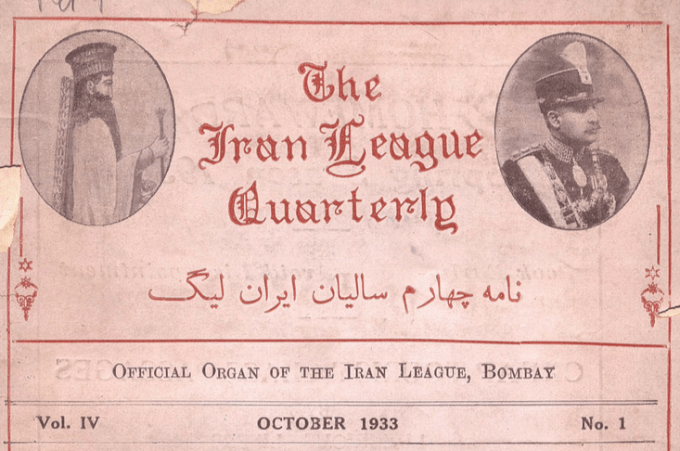
“The idea was to present Parsi interests before Iran and to build a bridge between India and Iran,” Patel says, stressing that the project was never narrowly sectarian — Hindus, Muslims and Zoroastrians alike were drawn into its orbit. The reasons for this were deeply personal. From the 1840s onward, waves of Zoroastrians fled Iran for Bombay and Pune, escaping persecution, famine and poverty. Unlike the Parsi community that had arrived in India over a thousand years earlier, these newer arrivals — the Iranis — carried Iran with them as living memory, not distant legend. “Many of the League’s founding members were the children and grandchildren of these migrants, for whom Iran was not an abstraction but their homeland,” Patel notes.
When Bombay dreamed of a modern Persia
Perhaps the most startling revelation of the evening was how optimistic, even romantic, Bombay’s Parsis once were about Iran’s future. In the 1920s and 30s, a reformist Iran under the early Pahlavi era seemed to many a beacon of modernisation — so much so, Patel told the audience, that early Parsi travellers packed tinned food from London before setting off, unsure of what awaited them in an “undeveloped” Iran. The League functioned as an entire support infrastructure for Parsis seeking to reconnect with their ancestral homeland. It helped arrange travel, offered language lessons, acted as a guide for visitors to Iran and lobbied for Parsi interests during the Indian Independence Movement. Underpinning these activities was a larger ambition: the belief that closer cultural, educational and commercial ties between Parsis and Iran would continue to deepen. “Those hopes were dashed by 1940,” Patel observed dryly — a reference to the upheavals of the Second World War and the changing political realities that curtailed many of those exchanges. Any lingering expectations of a renewed relationship were dashed again, more decisively, after the Iranian Revolution of 1979.
Keepers of the archive
If the League’s original mission — bridging two nations that lacked formal ties — became redundant once India and Iran established embassies, its purpose has only grown more urgent: custodianship. Dr Kerwam Daruwalla, project coordinator for the TISS-Parzor Academic Programme, is a volunteer and scholar of Iranian history who has spent the last year cataloguing the League’s collection, calls it a “treasure trove of manuscripts and quarterly journals stretching back a century, found nowhere else in the world. They document decades of cultural and trade exchange between India and Iran.”
The League, thus, operates more as a custodian of memory these days. “Its energies are directed towards preserving rare archives, digitising collections, organising lectures and competitions, and introducing younger Parsis to traditions that earlier generations absorbed almost by osmosis,” says Daruwalla, 46. It no longer has a formal membership base and is sustained by a handful of trustees and volunteers, although membership remains open. Most activities are coordinated by email, drawing a largely Mumbai-based audience, with around 40 per cent of participants under 40 and many of them students. For Zarine Commissariat, 78, a trustee of the Iran League, who attended Friday’s talk, and says she personally knew co-founder Adenwalla, the League’s relevance today is, “about continuity, community”, and — she adds with a laugh — “the food”.
A complicated mirror, a century on
Patel acknowledges that the steady exodus of Iran’s own shrinking Zoroastrian community — increasingly bound for Canada, Australia and the United States rather than India — has diminished some of the romanticism that once surrounded Iran among Parsis. The country that inspired such fascination in the 1920s and 1930s, he adds, is also not the one most people encounter in the news today.
Patel, however, refuses to reduce Iran to the headlines. “The idea we have of Iran in the news is very one-sided,” he says. The Iran preserved in the League’s journals and correspondence is a more layered place: one that exchanged literature, ideas, scholars and visitors with Bombay long before geopolitics narrowed the conversation. Organisations such as the Iran League, he suggests, offer a reminder of those connections — and of a world in which identities, cultures and loyalties travelled more freely than today’s narratives often allow.