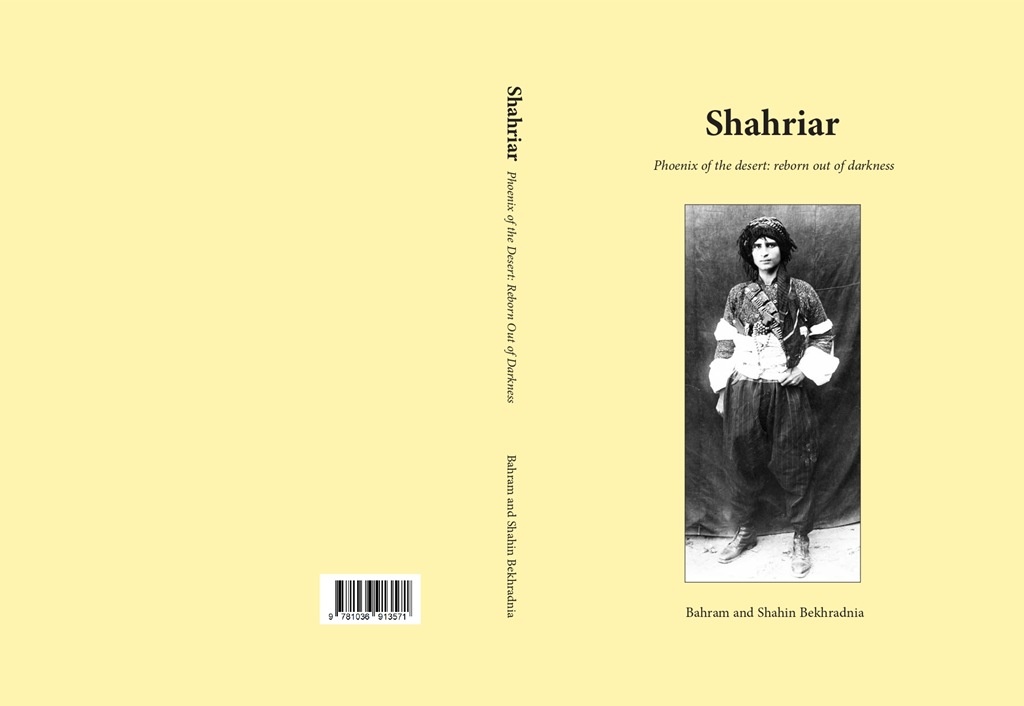
Our dearest friend Zerbanoo Gifford writes a beautiful review on a new book titled: “Shahriar: Phoenix of the Desert, Reborn Out of Darkness by Behram and Shahin Bekhradnia.”
As a young girl, my parents took me to see a Zoroastrian, from Yazd, who had been blinded while in the Persian army, fighting for Iran. I was told that he was a great man. On meeting him, I knew I was in the presence of someone very special. I never met him again, or his wife, Lall. But I have never forgotten that special day. Recently, I have worked closely with his dynamic daughter Shahin and been introduced to her brilliant brother Behram. Their biography of their extraordinary father is a most rewarding book on many levels. First and foremost, it tells the story of a remarkable man who led an astonishing life. It is beautifully told in an idiosyncratic but most appealing style, describing an environment and cultures that most will be unaware of. It is objective and dispassionate, but the underlying emotion is unmistakable. And it tells of kindness and generosity towards strangers in post-war Britain– of a kind that it is difficult to imagine today.
Born a Zoroastrian into abject poverty in a desert, Shahriar’s outstanding talents were recognised when he was just 7 years old, and he went on to complete his education, first in an orphanage and ultimately in the Military Academy. The book records his battles after losing his sight fighting as an officer in the Persian army against the Soviet-inspired Azeri and Kurdish uprisings; and his move to England for (unsuccessful) treatment, where, despite his very modest means, he enabled his children to integrate successfully into British society.
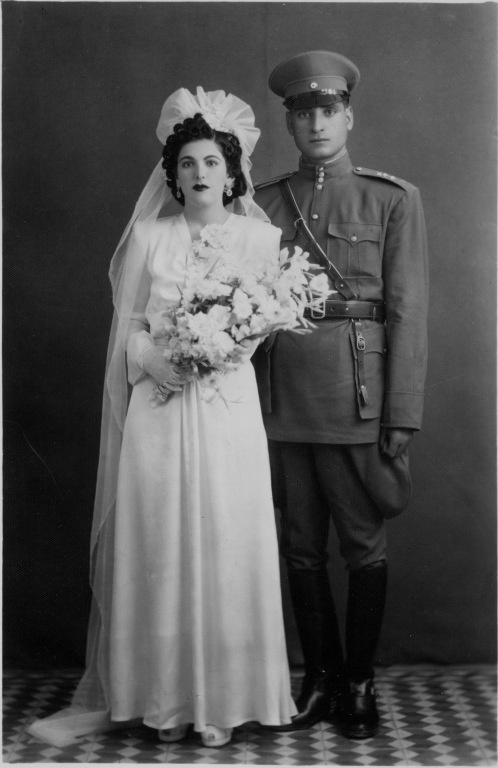
The book is in two more or less equal parts and moves seamlessly from Iran to England where Shahriar is sent by the Shah for treatment to try to restore his sight.
The narrative moves on at a pace, and the narrative is balanced with some fascinating detail. The book cleverly uses boxes to fill in background information about Zoroastrianism, the pre-Islamic religion of Iran, and the persecution Zoroastrians suffered in the 19th and 20th centuries (and still do to some extent); the ingenious (qanat) watering system that enabled desert villages and even farms to thrive, Perian gardens (baghs), Bombay tea houses, and Mehr Baba – an Indian Guru whom Shahriar and his family followed for a while. Perhaps it would have been at the expense of interrupting the narrative to have had more such information, but these are fascinating details.
However, the book does also contain historical detail – such as the reforms of Reza; how Iran was divided between the Soviets and the British, the Soviets reneging on the treaty which required them to withdraw after the war, in an attempt to support the Kurdish and Azeri insurrections that Shahriar was sent to counter and which led ultimately to his tragedy. All this is recounted in a dispassionate way, and in sufficient detail to satisfy the needs of the narrative.
Some of the most powerful elements of the book are the descriptions of Shahriar’s feelings and emotions – on lying injured on the battlefield unable to move or see; on being told that he will never see again; on being told that a benefactor had donated a house for him and his family to live in rent free in perpetuity. These are based on conversations with him over many years – but nevertheless one cannot but suspect that the authors exercised a degree of poetic license (as they recognise in the preface) and imagined their reactions had they been in his place. How these are beautifully imagined and described, and poetic license or not, fully justified in the context of the narrative.
Oral history is difficult. But it is doubly difficult and fraught with danger when it is the basis of a biography written by the subjects’ children. However, the book avoids a descent into a simple hagiography. Although admiration for their father and his struggles and life are apparent throughout the book, there is a ‘warts and all’ dimension as well – the recognition that Shahriar brought with him prejudices that would not be acceptable today, his political differences with his son, and the cultural tensions between him and both his son and daughter (as when his daughter announced to his consternation and anger that she planned to meet a boy after school the following week). The other thing that shines through is how Shahriar lived his Zoroastrian faith throughout his life. Particularly striking is that ” We were never aware of any untruth that passed his lips”.
Although this book is about Shahriar and his life, he is not the only hero. St Dunstan’s collectively – the charity that support blind servicemen – provided remarkable support and generosity (for example, having trained him as a telephone operator, applying for 53 jobs on his behalf before they succeeded); Miss Goole the St Dunstan’s welfare officer who kept a close eye on Shahriar and his family, their needs and problems, and, in a letter to Shahriar as she retired declared how moved she had been when she first met him and “full of admiration for the wonderful spirit you showed in this bitter blow to your ambition; you were so brave, and so patient, and so sensible, all alone in a foreign land; Miss MacAndrew of whom the book says little, but showed unimaginable generosity by giving what in today’s money was £100,000 for St Dunstan’s to provide a house exclusively for the use of Shahriar and his family (yes, you could buy a house in London for the equivalent of £100,000 at that time!).
But above all Laal, Shahriar’s wife, who scarcely saw her husband after her arranged marriage because he was on tours of duty around Iran; had a stillborn child and found herself married to a virtual stranger who had lost his sight. She could have remained in Iran with her son, conceived shortly before Shahriar came to England for his treatment – in a moving part of the book, Shahriar writes to his wife explaining that he would not be returning to Iran and absolved her of any obligations. But despite this, she chose to join him in a strange country with cultures and language that were totally unfamiliar, knowing that life would be hard not just because of his blindness but because of their economic circumstances. And yet she came and not only supported him but helped raise two children who, in their own words, became successful members of the British middle class. She, too, was clearly an extraordinary woman, and although the book has an appendix devoted to her, it would have been good to know more about her and her life.
There are many gems in this book, which deserve a wide readership – but above all, it is about Shahriar, his life and his extraordinary character. And how he overcame his misfortune to lead an exemplary life that, despite his disability, many would find enviable.
The book can be ordered from [email protected] for £10.