

The designer has turned a ritual wardrobe into a piece of living heritage
by Butool Jamal | The Nod Magazine
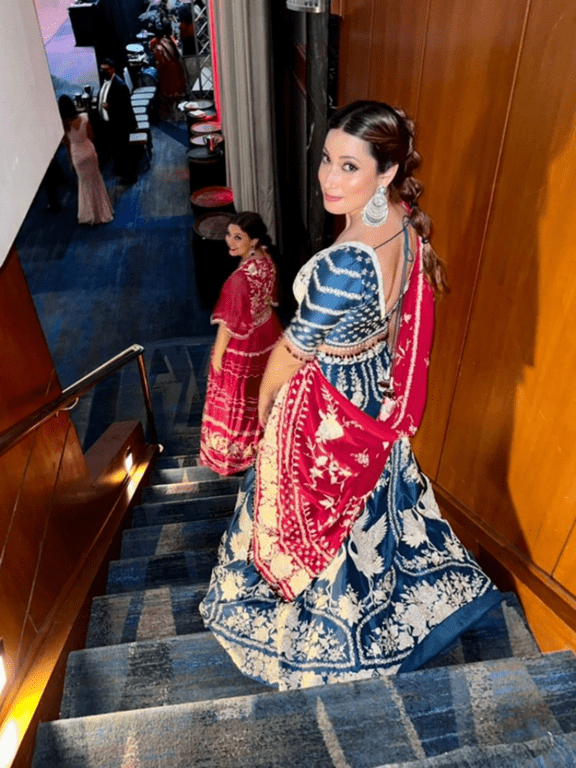
Natalia J Mistry in an Ashdeen lehenga
Ashdeen Lilaowala is probably the quietest rebel you’ll ever meet. At 45, the designer is charming, warm—the Delhi fashion frat loves his Navroze parties—yet his gentleness belies the way he is slowly redefining what gara embroidery can look like and mean to the Parsi community and beyond.
Lilaowala describes gara as “painting with a needle” for its realistic depictions of flora and fauna, most often with Chinoiserie influences. But gara is more than just a series of motifs, it’s a shorthand for the Parsi community—their peripatetic history, their aesthetics, their values told in thread. Gara saris are typically worn for weddings, for coming-of-age ceremonies or Navjots, milestones that justify the weight of an embroidery that’s heavy with cultural significance. “But the history of the craft is that there was no rulebook,” says Lilaowala. “And the fact that it evolved all the time even when it was at its prime and peak. So why not take things further?”
It’s a good question and that’s exactly what he’s done with his eponymous brand Ashdeen over the last 13 years. On his saris, he’s magnified the gara’s signature motifs of flying cranes, roses and peony flowers. He’s added breathing space. Kanda-papeta—polka dots named after onion and potato—have become playful punctuation marks instead of decoration-by-default. He’s introduced organza and net, lighter surfaces that moved differently on the body. He even let embroidery travel—onto palazzos, jackets, blouses, scarves—so it could be championed beyond the sari-wearers. In 2024 he released a line that paired embroidery with bandhini dyeing. That same year he also dropped a collection that spotlighted leheriya. Further back in 2022, he collaborated with Chennai-based Kanakavalli for a range of kanjivaram saris and before that in 2016 he worked with Ekaya Banaras on Benarasi saris and lehengas accented with gara embroidery.
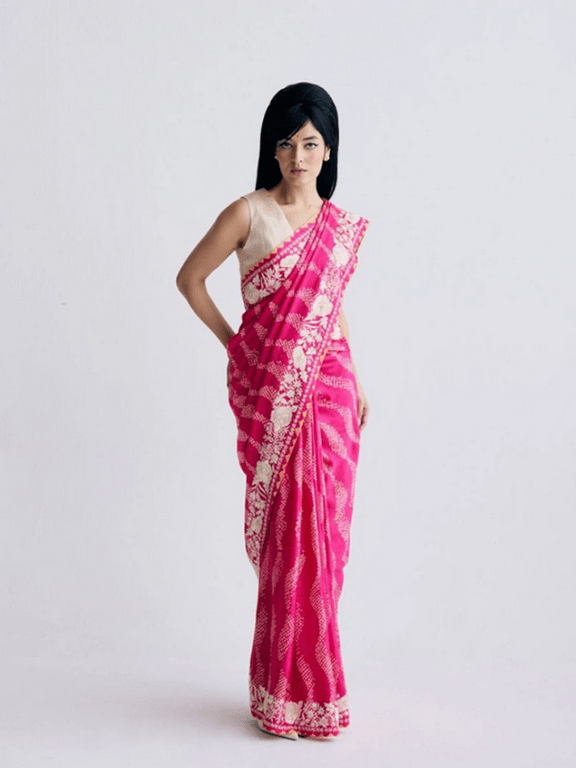
An Ashdeen sari with delicate bandhani dots arranged in leheriya-style geometric lines and a Parsi gara border
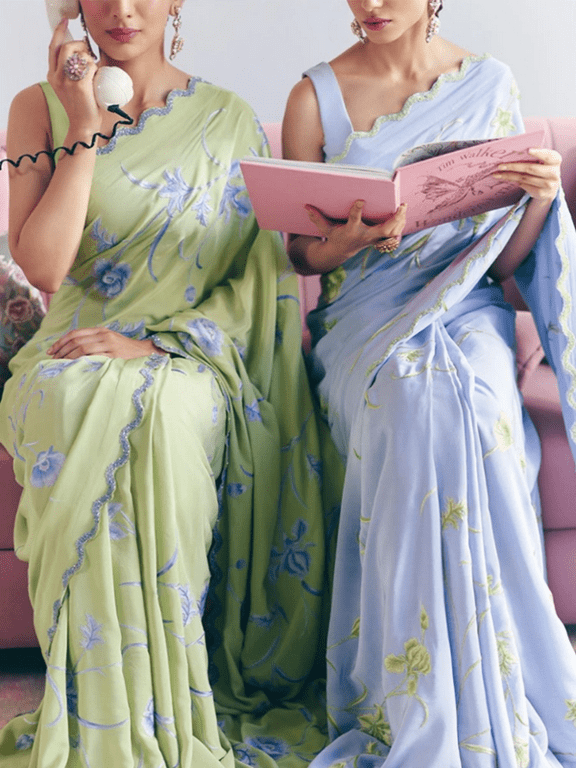
Saris from ‘The Grand Bharuch Hotel’ collection
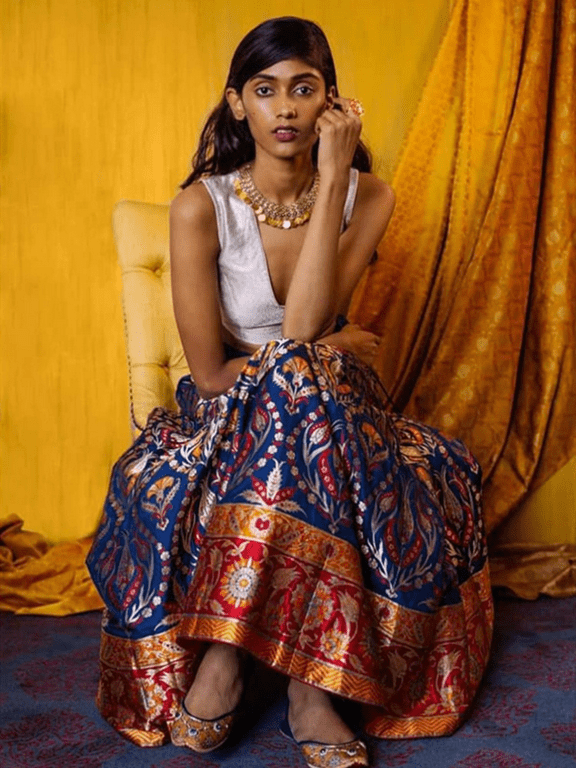
A lehenga from the collaboration with Ekaya Banaras
The last one triggered a historian to publicly call his work a disservice to the community, to the craft. He recalls, “I spent two days thinking, ‘oh my god, have I done something terrible?’” Luckily sales of those Benarasi looks were through the roof and one of the pieces even ended up in an exhibition at the National Museum in Delhi. To some, clearly, his interventions feel destabilising. To others, they are liberating.
For Natalia J Mistry, 27, director at Della Group, Lilaowala is practically a part of the family. He’s made saris for her mother, customised the collars of her father’s dugli (a ceremonial men’s jacket-style shirt), made matching-but-different looks for her and her sister. But even within a family Lilaowala knows there is a difference in what each generation seeks. “He always senses what my mom will want—something classic, but not too traditional. And for us, something contemporary,” says Mistry. Her favourite: a pair of palazzo pants that have gara embroidery on the hem. She’s worn the trousers to fashion events, to networking dinners in London or New York, and paired them with everything from a white shirt to crop tops. “Each time, people tell me that they love it, and they love that as a young woman I’ve chosen to represent my culture. There’s always curiosity and then questions that come afterward.”
For many of Ashdeen’s Gen Z clients, wearing a gara can often start as an obligation, but it quickly ends up being a choice. Zyra Nargolwala wore her first gara for her Sari Perewanu, or Sagan, a coming-of-age ceremony. “My grandmom insisted that it would be lovely for me to wear a gara, that it was a lifelong sari,” says the singer and artist manager. But it was Lilaowala’s interpretation with shimmer, pearls and a lighter pallu that made her choice of sari feel wearable rather than ceremonial. “I’ve worn it five times since and I’ve never not gotten a complement on it,” she adds. Each time, Nargolwala styles her gara a little differently, changing the drape, the blouse, swapping the traditional pairing of pearl jewellery for uncut diamonds and rubies. “I did initially get the nudge from my grandmom but now I’ve started wearing it myself. No one my age is wearing garas so no matter what event I go for, no one will be clashing with me. And even if they are wearing a gara I know that no two pieces are the same.”
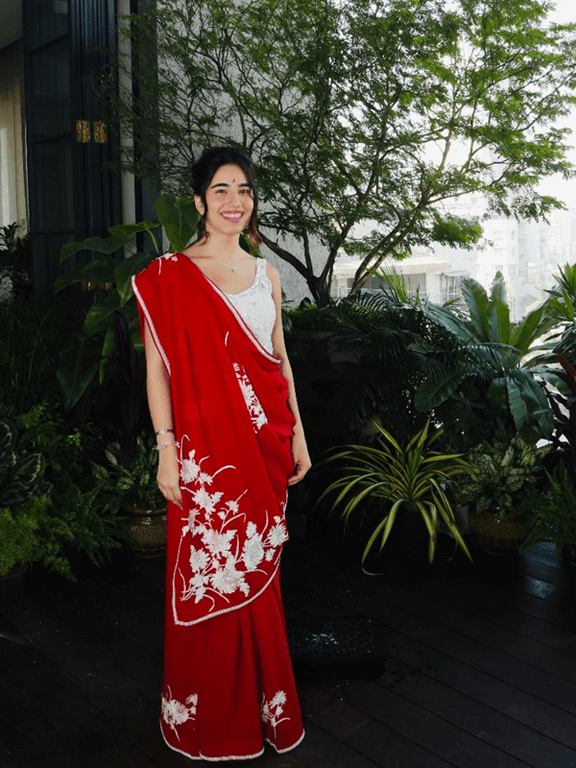
Zyra Nargolwala in a red Ashdeen lehenga featuring floral gara embroidery
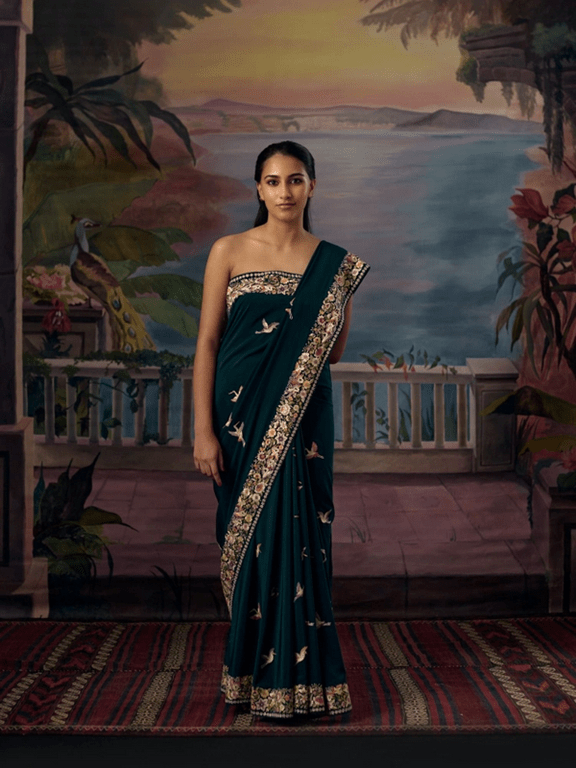
Aavienda Chowdhury in Ashdeen’s Mother’s Day campaign
This is also what drew 18-year-old Aavienda Chowdhury to Ashdeen’s garas. “My mom has been buying saris from Ashdeen for ages and so I stole one from her collection when I was old enough—with permission of course.” The one she borrowed was a deep, teal green embroidered with gold flowers and butterflies that she wore for a special occasion. “I remember being captivated by how light it felt, despite the richness of the embroidery. It made me change the way I thought of my wardrobe especially in terms of clothes that celebrate my culture.” Since then, the Singapore-based student has started embracing gara in other ways. “Sometimes it’s through a blouse with embroidery inspired by gara motifs, other times I find myself drawn to florals, vines and thread-work reminscient of gara even in Western silhouettes. It’s less about formality and occasion and more about identity.”
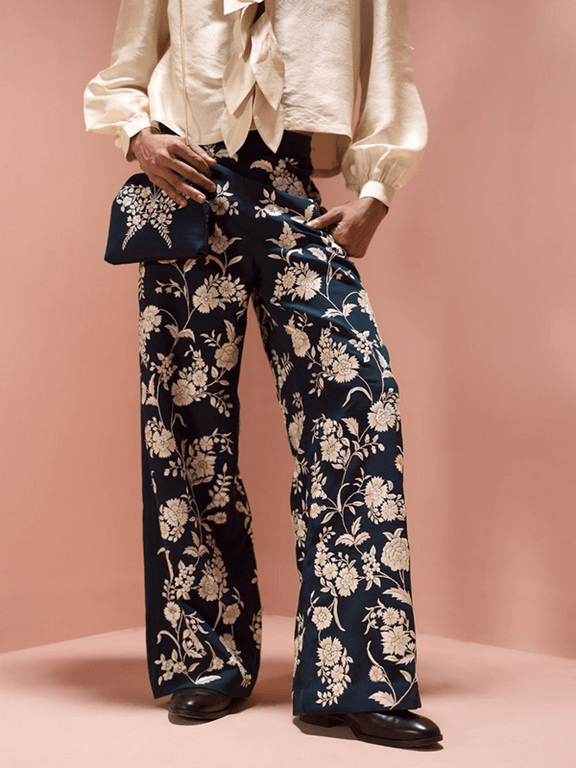
The Luna pants from Ashdeen’s 2025 collection ‘Inheritance’
For the new guard, Lilaowala is like a mentor or a knowledgeable friend, one who is happy to explain motifs and histories without demanding reverence. He’s trusted by their parents but doesn’t correct how they wear the garment. Instead, he allows curiosity to lead and it’s this generosity and a shared rebellious spirit that his younger customers relate to.
Like them, Lilaowala also didn’t want to be put in a box when, as a creatively-minded teenager, he applied to NID, Ahmedabad in 1998, eschewing a possible career as a doctor to become a designer, researcher, and revivalist. That same maverick confidence carried forward as he travelled across China and Iran to document and research the story of Parsi textiles, eventually resulting a book, Threads of Continuity – The Zoroastrian Craft of Kusti Weaving and then starting his own label in 2012.
“Right from the start I was very clear I wanted to do contemporary Parsi gara, not just the traditional borders and things like that,” he says just before signing off our call. “It’s our ongoing mission to push the Parsi gara in new directions and engage with younger generations of Parsis and non-Parsis too.”