

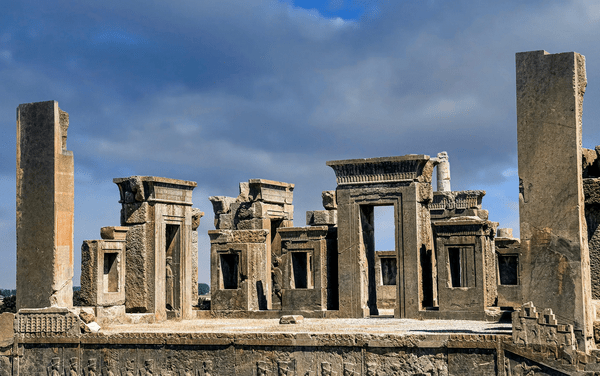
The palace of Darius I at Persepolis / Alamy

Damage to Iran’s world heritage sites
Sir, We are deeply concerned not only about the humanitarian impact of the war in Iran but also about reports of damage to that country’s cultural heritage. Cultural heritage is always at risk in the event of heavy bombing.
Buildings that are known to have suffered from bomb damage are the Unesco-registered world heritage sites of the Golestan Palace in Tehran and the buildings surrounding and near to the Maydan-e Naqsh-e Jahan in Isfahan, including the Masjid-Shah/Imam and the Ali Qapu and Chehel Sutun Palaces.
Elsewhere a provincial museum in Khorramabad has been completely destroyed. All this is a loss for the cultural heritage of the world, not just for the people of Iran. In addition, damage to oil depots and refineries inevitably results in pollution that causes irreversible damage to sites such as Persepolis and Parsargadae and famous rock-reliefs such as Bisitun, Naqsh-e Rostam and Bishapur.
Also at risk are Zoroastrian sites in and around Yazd.
Signed
- Professor Ladan Akbarnia, Fitzwilliam Museum;
- Dr Lindsay Allen, King’s College London;
- Professor Ali Ansari and Dr Vesta Sarkhosh Curtis, British Institute of Persian Studies;
- Professor Sussan Babaie, Courtauld Institute of Art;
- Dr Paul Collins, British Museum;
- Dr John Curtis FBA;
- Professor Robert Hillenbrand FBA;
- Professor Almut Hinze FBA;
- Professor Nicholas Sims-Williams FBA
Iran’s ancient treasures face threat from bombing, scholars warn
Richard Spencer The Times
Academics say strikes by Israel and the United States are putting mosques, palaces and some of Iran’s most precious heritage sites at risk
Historic mosques, ancient desert cities and palaces including the only Unesco-listed building in Tehran are at risk from the bombing campaign by the United States and Israel, according to academics.
In a letter to The Times on Monday, historians and archaeologists specialising in the Middle East say Iran’s cultural heritage is facing a crisis as a result of airstrikes.
They reflect concern also expressed by Unesco, the United Nations cultural organisation, which this month reported damage to Golestan Palace, the seat of the Qajar dynasty that ruled Iran from the end of the 18th century until 1925. It suffered blast effects from a strike on March 2 that left windows shattered and heaps of broken glass and rubble in its ballrooms.
“We are deeply concerned not only about the humanitarian impact of the war in Iran but also about reports of damage to that country’s cultural heritage,” write the letter’s authors, who include experts from the British Museum, Fitzwilliam Museum at Cambridge University and the School of Oriental and African Studies.
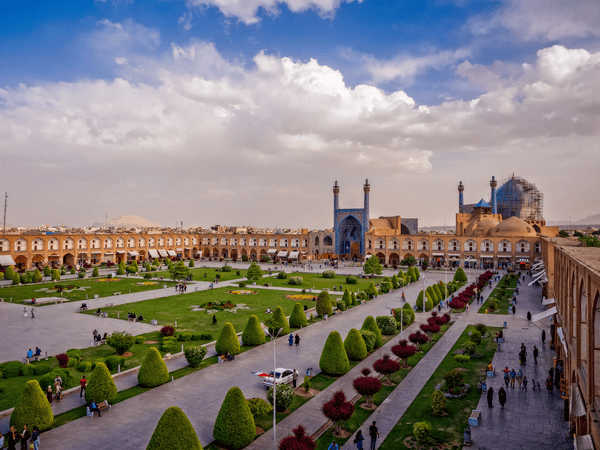
Naqsh-e Jahan square in Isfahan / Getty images
Iran’s rich history dating back to the times of the Assyrian and Persian empires, and climaxing with the distinctive religious architecture of the 16th-century Safavid dynasty, has been a draw to archaeologists and, in better times, tourists.
Golestan Palace was built in the late 17th and 18th centuries and remodelled by the Qajar shahs in the 19th century. According to Unesco, it was damaged by blast waves from a strike that hit nearby Arag Square.
There has also been damage to the palace of Chehel Sotoun, part of a 17th-century Safavid complex in Esfahan, and the city’s picture-postcard Naqsh-e Jahan square, flanked by mosques and palaces, which is one of Iran’s most important cultural sites.
A museum in the city of Khorramabad has been completely destroyed. “All this is a loss for the cultural heritage of the world, not just for the people of Iran,” the authors say.
Ali Ansari, a professor of Iranian history at the University of St Andrews and president of the British Institute of Persian Studies, said the nature of the war made it unclear as to how the international community would be able to help repair the damage in the future.
Many western museums and other institutions are working with archaeologists in neighbouring Iraq to try to undo some of the harm caused by years of turmoil and Islamic State destruction.
Ansari said he hoped that some of Iran’s unique ancient sites, such as Persepolis, its capital in the times of the emperors Darius and Xerxes, would be protected from attacking forces.
“I would like to think the Americans and the Israelis have a little bit of a red alert there,” he said.
But there is also concern at the actual and potential damage from the polluting effects of the war as it progresses. In the first week, Israel hit oil depots around the capital, Tehran, blanketing the city in a fog of noxious black fumes. Toxic pollution can eat away at the exteriors of sensitive ancient sites.
“Damage to oil depots and refineries inevitably results in pollution that causes irreversible damage to sites such as Persepolis and Pasargadae and famous rock-reliefs such as Bisitun, Naqsh-e Rostam and Bishapur,” the letter’s authors say.