
Parsi-American Scholar Dr. Mahzarin R. Banaji Honored by Carnegie Foundation
Harvard social psychologist, author, and 12th World Zoroastrian Congress speaker honored as the United States marks its 250th anniversary.
Dr. Mahzarin R. Banaji, the distinguished Parsi-American social psychologist whose work has transformed public understanding of implicit bias, has been named to the Andrew Carnegie Foundation’s 2026 class of “Great Immigrants, Great Americans.”
The annual Carnegie recognition honors 25 naturalized citizens whose contributions have strengthened American life across fields including science, medicine, education, business, technology, the arts, and public service. This year’s honorees were announced as the United States prepares to mark the 250th anniversary of the Declaration of Independence.
For the global Parsi-Zoroastrian community, the recognition is a source of particular pride. Dr. Banaji’s journey from India to the highest ranks of American academic life reflects a career devoted to rigorous scholarship, public education, and a clearer understanding of human behavior.
A Parsi Childhood and an Academic Journey from India to Harvard
Born and raised in Secunderabad, India, in a Parsi family, Dr. Banaji studied at Nizam College and later earned a master’s degree in psychology from Osmania University in Hyderabad. She came to the United States for advanced study and received her Ph.D. in social psychology from Ohio State University in 1986.
Dr. Banaji went on to teach at Yale University for 15 years before joining Harvard University, where she is the Richard Clarke Cabot Professor of Social Ethics in the Department of Psychology.
Over several decades, she has become one of the world’s most influential scholars in social psychology, particularly in the field of implicit social cognition: the study of attitudes and associations that can influence judgment and behavior without conscious awareness.
Understanding Implicit Bias and the Human Mind
Much of Dr. Banaji’s work addresses a difficult but essential question: why do people who sincerely value fairness sometimes make decisions that do not reflect those values?
Her research explores the gap between conscious beliefs and the automatic associations people absorb from their environments, cultures, histories, and social institutions. These associations can affect whom people trust, hire, promote, teach, fear, or overlook, even when there is no deliberate intention to discriminate.
In 1998, Dr. Banaji and Professor Anthony Greenwald co-developed the Implicit Association Test, widely known as the IAT. The tool was designed to help measure automatic associations related to social categories such as race, gender, age, and class.
Through Project Implicit and related research, the IAT brought the concept of hidden bias into public discussion and encouraged individuals, institutions, and communities to examine the assumptions that can shape decisions in ways they may not immediately recognize.
Blindspot: Hidden Biases of Good People
Dr. Banaji’s work reached a broad public audience through the acclaimed book Blindspot: Hidden Biases of Good People, co-authored with Anthony Greenwald.
The book’s central insight is both challenging and compassionate: people may hold unconscious biases not because they intend harm, but because the human mind constantly absorbs patterns from the world around it. Those patterns can shape our judgments even when they conflict with our most deeply held values.
Rather than treating bias as a flaw found only in others, Blindspot invites readers to develop greater self-awareness and to recognize the distance that can sometimes exist between intentions and outcomes. It also offers a framework for bringing everyday actions into closer alignment with ideals of fairness, dignity, and inclusion.
The book has been widely read by educators, business leaders, policymakers, health-care professionals, and others seeking a more thoughtful understanding of how hidden assumptions affect individual choices and institutional systems.
A Memorable Speaker at the 12th World Zoroastrian Congress
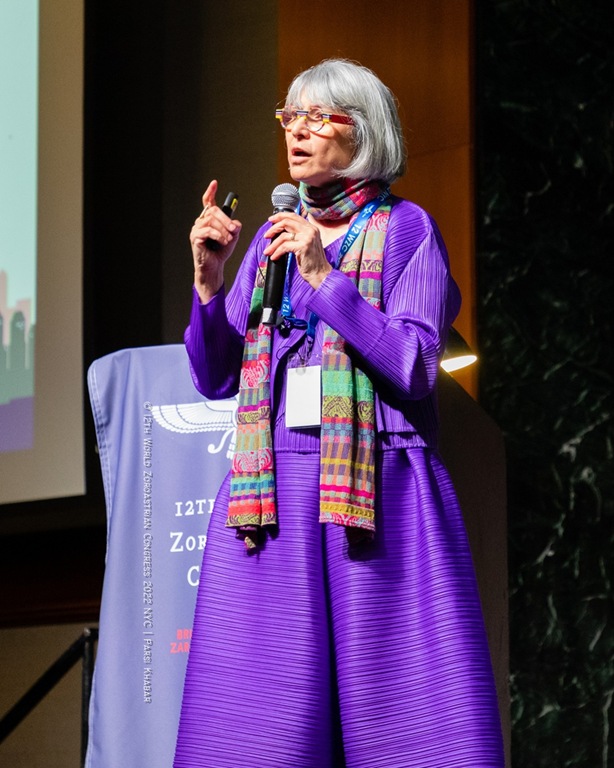
Dr. Banaji was also a featured speaker at the 12th World Zoroastrian Congress, held in New York City in 2022.
Her presentation, titled Blindspot: Hidden Biases of Good People, introduced Congress participants to the ways unconscious associations can influence perceptions and decisions. Her session encouraged attendees to reflect on how individuals can better understand their own minds, question automatic assumptions, and act with greater intention.
Her participation was especially meaningful in the context of a global Zoroastrian gathering. At a time when communities everywhere are considering questions of identity, belonging, fairness, and intergenerational continuity, Dr. Banaji’s work offered an important reminder: living by one’s values requires not only good intentions, but also the humility to recognize the limits of one’s own perspective.
For a community grounded in the ethical ideal of good thoughts, good words, and good deeds, her message resonated deeply. It suggested that the pursuit of goodness also requires continued self-examination and a willingness to see more clearly.
Recognition for a Lifetime of Influential Scholarship
Throughout her career, Dr. Banaji has received numerous honors for her contributions to psychology and cognitive science. Her research has shaped academic inquiry and public discourse on prejudice, stereotyping, decision-making, and social perception.
The Andrew Carnegie Foundation’s recognition honors not only her scholarly accomplishments, but also her commitment to making complex research accessible and relevant beyond the university. Her work has equipped people in schools, workplaces, courtrooms, hospitals, and communities with a more honest vocabulary for discussing the hidden influences that shape human behavior.
As a Parsi scholar whose intellectual journey began in India and flourished in the United States, Dr. Mahzarin R. Banaji stands as an inspiring example of how research, reflection, and public engagement can help societies understand themselves more clearly.
Her recognition as a Carnegie “Great Immigrant, Great American” is a fitting tribute to a career that has challenged people to look beyond what they believe they know about themselves — and to strive for a more just and thoughtful world.