

Twenty-five fire tenders battled the blaze in central Calcutta for over six hours from 5.30am, when the first alarm reached the Kolkata Police headquarters, Lalbazar
A fire that broke out early on Saturday morning at a godown on Ezra Street left Calcutta’s first Parsi fire temple — the 186-year-old Rustomjee Cowasjee Church — severely damaged, along with more than a hundred shops selling electrical goods and other items.
Article by Kinshuk Basu | The Telegraph
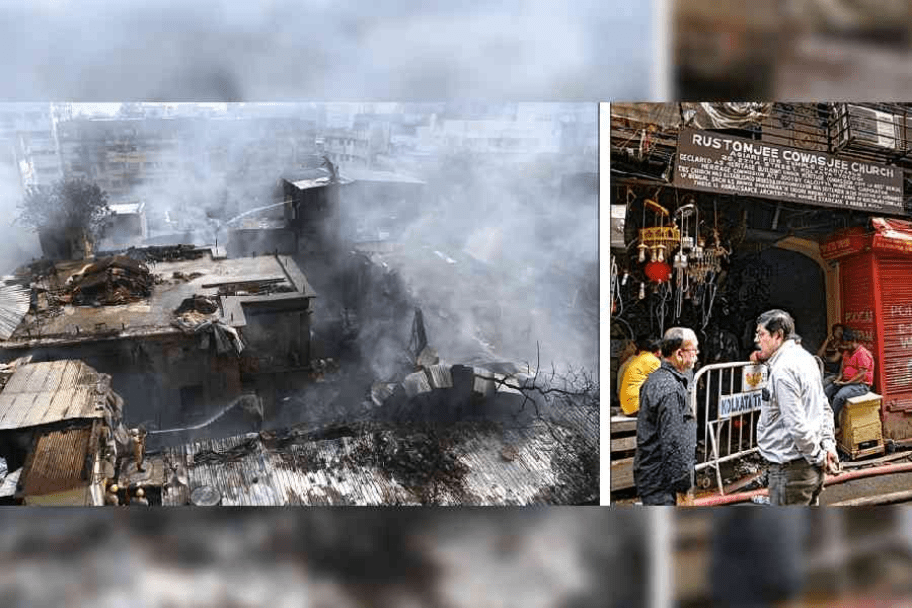
Twenty-five fire tenders battled the blaze in central Calcutta for over six hours from 5.30am, when the first alarm reached the Kolkata Police headquarters, Lalbazar. Flames spread from one building to another in the tightly packed commercial hub, triggering panic among traders who rushed to salvage whatever they could. Police confirmed that no one was injured.
The Parsi fire temple at 26 Ezra Street, established in 1839 and inaugurated on September 16 in the presence of luminaries including Prince Dwarkanath Tagore, is a heritage structure recognised by the Kolkata Municipal Corporation on the state heritage commission’s recommendation.
The Parsi Church is listed as a Grade-I heritage site in the KMC’s graded list of heritage buildings, where “no external change” is permitted under the rules. Built in Gothic style on a plot measuring a bigha and 18 cottahs, the temple lends its name to a narrow lane off Ezra Street: Parsi Church Street.
Today, the temple sits almost hidden behind rows of electrical shops that have mushroomed around it, with an adjoining building even sharing its address. Long-time residents said the neighbourhood’s documented history dates back to the 19th century, when Parsi and Jewish families settled in the area and established homes, businesses and places of worship.
“The temple on Ezra Street is the first Parsi fire temple in Calcutta. It is not in use now, but there are talks of reviving it,” said Yasmin Panthaki, a member of the city’s Parsi community. “Encroachment by shopkeepers has eaten into the temple’s space. We now visit the one on Metcalfe Street.”
Shopowners at the temple’s entrance said their establishments were among those badly damaged in the blaze.
Saturday’s fire revived grim memories of the April blaze at a hotel in Mechua — barely 4km away — that claimed 14 lives and injured 13.
Fire and emergency services minister Sujit Bose and mayor Firhad Hakim visited the tightly packed pocket behind Rabindra Sarani and Pollock Street, an area lined with old buildings, some allegedly with illegally added floors.
Traffic had to be suspended along both roads to allow fire tenders access, and electricity was disconnected as thick smoke blanketed the area, which draws thousands of traders daily.
Wholesalers and traders estimated losses running into several crores. “The fire started on the fifth floor of a building at 26 Ezra Street and spread up to the 12th floor around 5.30am. Since it was very early, by the time residents realised what was happening, the flames had reached adjoining shops,” said a senior officer of Kolkata Police’s central division.
Firefighters struggled to reach the seat of the blaze through the maze of narrow lanes packed with shops and buildings. A mesh of overhead wires further complicated ladder operations. As the fire raged, explosions were heard from locked shops and godowns.
“Twenty-five fire tenders were working to bring the fire under control. It won’t be possible to say how the fire started without a report from forensic experts. They will examine the site,” minister Bose said.
A section of traders said that most buildings lacked fire-safety measures and functional emergency exits. “We have been asking the fire department to inspect, but no one would listen,” said a trader dealing in electrical wires, requesting anonymity.
Bose said traders should also ensure fire safety norms are followed. “It’s not just the duty of the police or fire services to enforce norms. Businessmen, too, have their responsibilities,” he said.
Kolkata Police Commissioner Manoj Verma said that since the Bagree Market blaze in September 2018, the police, along with the KMC, have issued instructions to businessmen in and around Ezra Street and adjoining areas on the norms they must follow to prevent fires and the steps to take if a fire breaks out.
“Even then, we will investigate the cause of the fire and whether fire department personnel faced any obstruction in their work because of parked vehicles, as some residents have alleged,” Verma said.
“Officers from the police, fire services and the KMC check through the year whether the instructions are being followed. If there have been lapses, they will be probed and lawful action will be taken.”
The Congress councillor of the area, Santosh Pathak, said he had repeatedly alerted authorities to irregularities in the affected building. “I must have written at least 20 letters,” he said. “No one responded.”
Mayor Hakim said that the civic body was rarely informed when illegal constructions occurred. “People complain only when disputes arise. I meet Pathak twice a month at the KMC; he never told me about irregularities here,” Hakim said.
Ahead of World Heritage Week, blaze around Kolkata’s first Parsi fire temple spark heritage conservation dialogue
Article by Subhadrika Sen | Indian Express
Smoke and ashes around first Parsi fire temple in Kolkata spark conversations around heritage preservation.
Kolkata is a marvelous example of territorial co-existence of the old and the new. With colonial and community-built heritage monuments strewn over the city, what is interesting is to take note of the settlements growing around it. Surrounded by residential pockets or even marketplaces, the major concern that arises is of their safety and preservation in case of anything untoward happens in the nearby area. A prime example occurred this morning when fire broke out around Ezra Street near the first Parsi fire temple built in the City of Joy. Leaving the already degrading piece of heritage, severely damaged, the incident sparks a debate about how observant and serious we should be in protecting our city’s heritage, right ahead of World Heritage Week 2025 falling on November 19.
Digging deeper into the first Parsi Fire Temple in Kolkata
It is not unknown that Calcutta, as it was then called, was a melting pot of cultures. Right from the British to the Scots, Armenians, French and many other communities found home in the city. Not only did they not have flourishing trade, but they also formed a notable community of their own, which led them to build public monuments.
One such community were the Parsi’s and the Parsi fire temple, a first in the city, was built in 1839 by businessman Rustomjee Cowasjee. It gets way interesting from here because it was actually inaugurated with Dwarkanath Tagore in attendance on September 16, 1839. Today, the building stands on 26 Ezra Street, which has later got the name Parsi Church Street and has been declared a Grade I heritage building. Visitors are not allowed inside anymore as the structure itself is haunted by despair and encroachment so much so that it is in dire need of restoration.
Going deeper, the roots of a Parsi fire temple as the primary place of worship for the Zoroastrians or the Parsis, lies in Persia. The temple holds within its walls an ever-burning fire. This fire is said to be symbolic of purity and divine energy. It is a metaphorical representation of the divine power. Offerings like sandalwood and fine perfumes were often made to appease the fire. The temple also has attached community halls for gatherings and events. Although visitors are allowed, their presence is restricted to the outer area only, and those from the community have access to the inner sanctum.
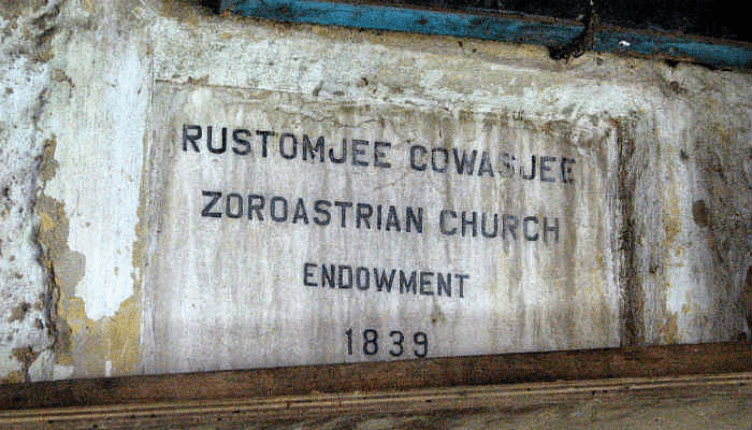
The Kolkata Parsi fire temple had stopped allowing regular visitors for a long time. In fact, if anyone was to go near the place, it could easily have been overlooked as a godown surrounded by shops of lights and chandeliers, irony much? And now with the recent case of fire breaking out in the neighbourhood, leaving the already damaged temple in further ruins, it is probably a wakeup call to get together and restore the monument to its erstwhile glory. In fact, there are several markers of old Calcutta, around the city, lying in equal neglect. Whether it is the Panioty Fountain or the McDonnell Drinking Water Fountain, Clive House, Prince of Wales Visit Memorial, and more are in dire need of attentive eyes to turn towards them, so that they can be saved from disappearing altogether.
Kolkata mayor seeks report on Parsi fire temple encroachment
Article by Saikat Ray | Times of India
Mayor Firhad Hakim on Monday asked civic officials to visit the city’s first Parsi fire temple at Ezra Street—a grade-I heritage structure—and submit a report on encroachment on its premises. Hakim discussed the encroachment issue during a meeting held at the Kolkata Municipal Corporation headquarters. The mayor said he had spotted several shops that had been set up illegally around the temple. “We need to take a stance as far as encroachment around a heritage building is concerned,” said Hakim.
In 2022, the KMC heritage committee members were left shell-shocked when they had gone to Ezra Street to inspect the building.They had found that hundreds of shops selling decorative lights had come up on four addresses in the area, which were marked on the heritage list. Such was the extent of encroachment that the Parsi temple was nowhere in sight. Only after they had negotiated the labyrinth of narrow passageways through psychedelic lights strung up at shops on either side, the team spotted a heavily encroached marble staircase flanked by Roman Tuscan columns, leading to a decrepit building.
To their surprise, they found a West Bengal tourism signboard that identified the building as the nearly two-centuries-old Rustomjee Cowasjee Banajee fire temple.The team had also learnt about a three-decades-old legal dispute over ownership of the property straddling 26, 27 and 31, Ezra Street, and 19, Parsee Church Street. A realtor claimed he had purchased the property. But the 100-plus shopkeepers contested the claim. The KMC team had even witnessed a face-off between the shopkeepers and the realtor that threatened to turn into a brawl. The fire temple’s last known trustee Cursetjee Manackjee Rustomjee had maintained that he had not sold the property to anyone. He died in 2018.
Blaze ravages a slice of city’s Parsi link as flames destroy 186-yr-old fire temple
The fire that ravaged Ezra Street also destroyed a slice of Parsi history with the gutting of the city’s first fire temple constructed nearly two centuries ago.The agiari or the fire temple was established in 1839 by Parsi businessman, shipbuilder, and philanthropist Rustomjee Cowasjee Banajee. Prominent citizens of Kolkata, including his close friend Prince Dwarkanath Tagore, were present at the inauguration.”Dastur Khurshed Bejon came from Mumbai to Kolkata on foot, carrying the ‘holy alaat’ that was required for the consecration ceremony attended by all the Parsis of Kolkata. After the Jashan, he announced that the religious rites of both the Kadimi and Shahanshai sects will be performed in this dar-e-meher and he also created a separate estate for the permanent upkeep of the dar-e-meher with the trust remaining in his control and after his death in the control of his heirs in perpetuity,” author Prohcy Numi Mehta wrote in the book Pioneering Parsis of Calcutta.
The private fire temple had a priest till the 1950s and continued to function until around the late 1970s when it was abandoned after the number of trustees declined and the last of the remaining descendants lost interest. While the eternal flame petered out years ago, Saturday’s fire consigned the temple to eternal darkness.”KMC mentions it as Rustomjee Cowasjee Church on its heritage list. But it was an agiari or fire temple.
Perhaps the nomenclature ‘church’ came from the British and stuck because the lane next to it was named Parsee Church Street. Since it was privately owned, the current generation of Parsis has little connection to it now,” recounted Bahadur Postawala. The community fire temple is Zoroastrian Anjuman Atash Adaran on Metcalfe Street.Once a magnificent structure with a marble staircase flanked by Tuscan pillars and a facade with Doric pilasters, the temple fell into disrepair over the past five decades. A portion of the roof — that leads to the landing beyond which lay the inner chamber — collapsed. Wooden beams that held up the roof caved in. The temple’s condition worsened following the death of the last known trustee, Cursetjee Manackjee Rustomjee, in 2018.Mehta, whose Navjote ceremony was performed at the agiari at the age of 7, recounted visiting the temple several times when she was a child: “I remember the sprawling courtyard around the agiari. Sadly, all that was encroached upon.” The grounds of the temple and even portions of the temple were taken over by hundreds of shops selling decorative lights. Such was the condition that the grade-I heritage building had become difficult to locate in the labyrinth of narrow passageways through psychedelic lights strung up at shops that crammed the entrance and courtyard around the temple. On Saturday, the shops went up in flames that consumed the last remains of the historic agiari.