

It’s hard to imagine that Bombay (now Mumbai) once came to a screeching halt over stray dogs. Almost 200 years ago, this city shut shop, marched in the streets, and very nearly brought the East India Company to its knees. All because the administration tried to mess with the city’s stray dogs.
Article by Rishad Saam Mehta | Live Mint
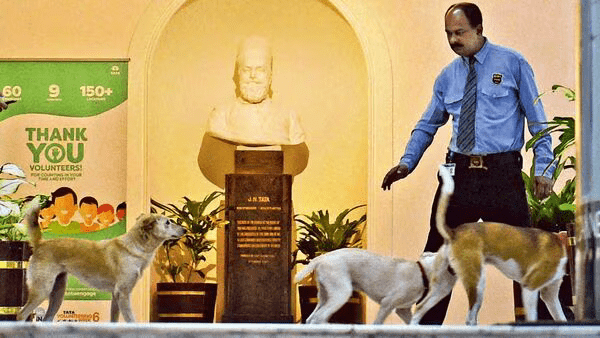
In the summer of 1832, when the fear of cholera had affected port cities worldwide, the British administration, ever fond of order and overreaction, decided that the city’s stray dogs were a menace—disease-ridden, aggressive, and far too free-roaming. So, they passed a decree: from 15 May to 15 October, any unclaimed dog could be killed, and a bounty would be paid for each carcass. In doing this, they effectively drew a line between bounty hunters and dog lovers. After all, sowing division was an Empire-building move patented by the British.
They couldn’t have imagined disagreement coming from the largely even-tempered Parsis, for whom reverence for dogs is stitched deep into their faith. At Zoroastrian funerals, the sagdid or dog’s gaze is a ritual that involves bringing a dog near the corpse. The dog’s presence is believed to repel evil forces that could disturb the soul’s journey to the afterlife. Parsis see dogs as sacred guardians of the threshold between life and death. And so, the decree was considered sacrilegious.
Dogcatchers, emboldened by the bounty and the law, began dragging away beloved street dogs, many of which had names and lived in the vicinity of Parsi homes and fire temples. On 6 June 1832, tensions boiled over. In the Fort area, a group of Parsis confronted the dogcatchers, and a riot followed. The British, used to deferential nods, were stunned—Bombay’s Parsis had gone from soft-spoken merchants and shipbuilders to street fighters.
Other communities joined the protest. Trade ground to a halt. Water and food supplies to the British garrison were blocked. Crowds gathered outside government buildings, demanding that the decree be scrapped. The British, unused to uprisings in their “model port”, panicked. A regiment was called in. A few dozen protesters were arrested. But the authorities quickly realised this wasn’t political subversion. This was more dangerous to colonial control: moral outrage backed by a united city.
Eventually, cooler heads prevailed. Prominent Parsi businessmen, skilled in the art of negotiation, met with the colonial administration. An agreement was reached. The culling would stop, and strays would be relocated outside Bombay. It wasn’t perfect, but it stopped the killing. The arrested protesters were released. The shutters went up. And in some Parsi neighbourhoods, dogs were fed special treats and garlanded—or so the community’s elders still say.
The Bombay Dog Riots of 1832 is an important footnote in history when faith and respect for animals went up against the might of a colonial power. The whole affair lasted only a few days, but left paw prints on the city’s history. Bombay’s street dogs still weave between traffic, sleep under shop counters, and in Parsi colonies and baugs they are well-fed, vaccinated, sterilised, named and loved. And they still inspire fierce loyalty in the people who care for them.
Rishad Saam Mehta is an electronics engineer-turned-travel writer, based in Mumbai.
Thank you for sharing this historic article. There should be a middle ground that provides for food and shelter for stray dogs, like they have the Panjrapol in Mumbai where stray animals are rescued and provided with food and shelter.