

Our third author in the Everyday Parsi 2025 series is Dr. Shernaz Cama
The Living Presence of the Fravashis
By Dr. Shernaz Cama
Muktad in childhood was a time of joy and excitement. The scent of roses, mogra, and tuberoses from the corridor—where photographs and portraits of our ancestors were kept—wafted through the house. Silver vases gleamed and sparkled. Each of the ten days brought new clothes, which we wore proudly to the Parsi Gymkhana, on the banks of the Sabarmati River in Ahmedabad.
Mornings were filled with the quiet dignity of elders gathering in their special Muktad saris with intricate borders, returning from the Vakil Adarian with the scent of loban and sandalwood lingering on them. As we grew older, we were allowed to accompany them on the Gatha days—entering a wonderland of memory and reverence.
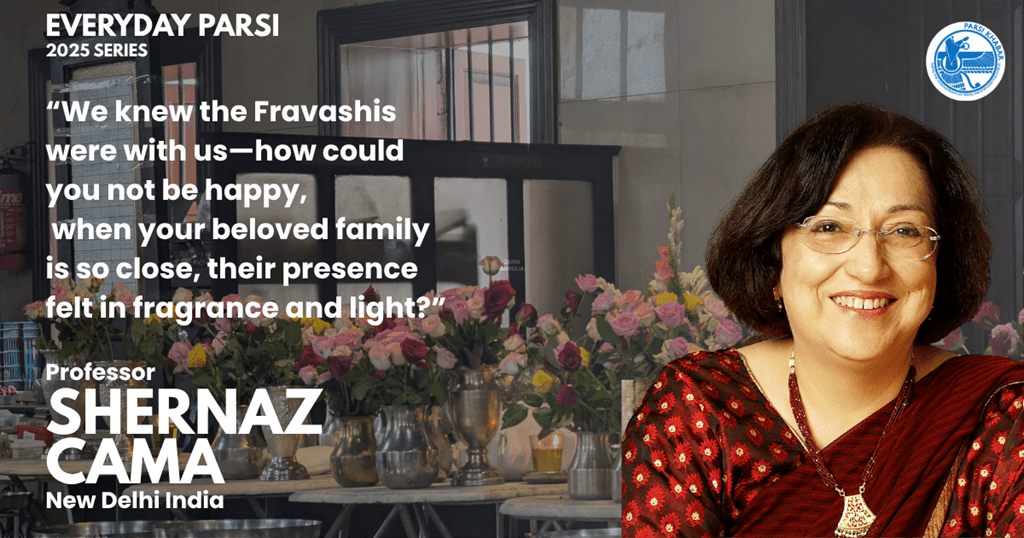
Rows of marble and brass tables lined either side of the Fire Temple, each table holding silver Muktad vases overflowing with fresh flowers. It is the scent and the soft light of the divas on each table that return to me most vividly. We knew the Fravashis were with us—at home and in the Agiary—and we were taught to welcome them with smiling faces, their favorite foods, and a home made ready in their honor.
Muktad was never a time of sorrow. How could it be, when our beloved family was so close—loving us, protecting us—their presence felt in the fragrance of flowers and the polish of silver? Each evening, dressed in our best clothes, we returned to the Gymkhana, now decorated with twinkling lights. We played games with the whole community and gathered for the Ghambar. One year, I remember especially clearly: a gara competition. This was the 1960s, long before the gara had made its fashionable comeback. In a long line of elegant women stood my mother, Khorshed Sethna, dressed in her black Japanese gara, her hair styled to perfection. That vision—of her beauty, grace, and gentleness—has stayed with me always.
As the years passed, and I began to study our religion and culture more deeply, the Muktads took on immense spiritual significance. I would wake at 5 a.m. to clean the Muktad room in my own home, arranging fresh flowers before photographs—each one now filled with personal meaning. Beloved grandparents. Parents. Friends. Even family pets who had been like my children. They all looked back at me. I felt their presence tangibly, and often they would come to me in dreams during these sacred days.
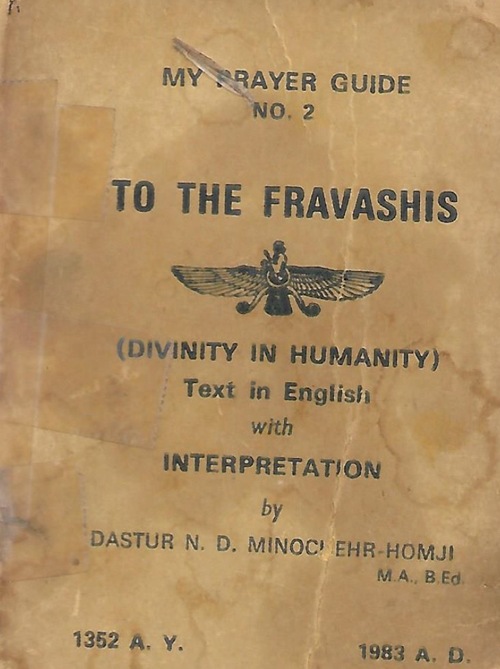
After reciting prayers from the Khordeh Avesta, I would turn to a treasured book left to me by my late father, Lt. Gen. Adi Sethna: Dastur N.D. Minocher-Homji’s Prayer Guide to the Fravashis, with English interpretation. It gave me both understanding and comfort. The Fravashis’ “moving presence amongst us” became something deeply real.
On the Gatha days, I turned to I.J.S. Taraporewala’s Gathas from The Religion of Zarathushtra. His free English renderings for each of the five days offered a spiritual message that carried me through the year. Zarathushtra echoed my questions. His doubts found clarity in faith, and through his holy word—his light—I felt close to my Prophet Teacher.
In his voice, I found comfort:
“So, Ahura Mazda, I would ask of Thee
A vision of Thyself and speech with Thee.”
Ahunavaiti Gatha 6.6 (Yasna 33.6)
And again:
“Thou art Divine, I know, O Lord Supreme,
Since Good found entrance to my heart through Love.
This taught me that for steady inner growth,
Quiet and silent meditation’s best…”
Ustavaiti Gatha 1.15 (Yasna 43.15)
At the end of the five days, the final Gatha leaves me with a blessing:
“The promise unto all His Brotherhood
Hath Zarathushtra made, that their reward
Shall be the House on High, wherein doth dwell
As first and foremost Mazda Ahura;
Such the reward that Vohu Man’ bestows,
Such Asha’s blessings, that I promised them.”
Vohu Khshathra Gatha 15 (Yasna 51.15)
And so, each year, the Muktads return with renewed meaning. Listening to the prayers in the Delhi Dar-e-Meher, hearing the roll call of those who have gone before, I feel a deeper sense of hope. There is strength in knowing that after this life, those beloved ones will be waiting—in Garo Demana.
Editor’s note: We are grateful to Professor Cama for sharing the PDF of the book “Prayer Guide To The Fravashis” referenced above. Click image to download in PDF format
About Professor Shernaz Cama
Prof. Shernaz Cama is the Director of the Parzor Foundation. She taught at Delhi University for several decades and continues teaching in the academic programme she founded: the TISS-Parzor Programme on Culture & Civilisation: A Zoroastrian Perspective. She is an Advisor to the Fulbright Educational Programme, Trustee of the Temple of Understanding, and Honorary Research Fellow at the University of Exeter, in addition to serving on the Board of Governors of the Indian Spinal Injuries Centre, New Delhi.
In 1999, Prof. Cama was invited by UNESCO to initiate a project on the preservation and promotion of Parsi Zoroastrian culture and heritage. As the Honorary Director of UNESCO Parzor, she has guided—and continues to guide—researchers in Parsi Zoroastrian culture and demography in India and abroad.
Prof. Cama has produced films and curated exhibitions, including The Everlasting Flame International Programme (2016), among others. Her publications include the seminal Threads of Continuity: Zoroastrian Life & Culture.
She has received several prestigious international awards from UNESCO and Zoroastrian associations worldwide for her work on Zoroastrianism. She is also a recipient of the Sarojini Naidu International Award for Education.