
Today is the Spentamainyu Gatha, the third Gatha day of this year’s muktad. And in the 2025 Everyday Parsi series we feature our eighth author Roshan Rivetna.
Muktad Memories – From Mumbai (Bombay) to Chicago
Early Days in Mumbai
My early days, growing up in Bombay (Mumbai), were spent between my Bapaiji’s flat on Gowalia Tank Road (it has since been renamed after someone else — I don’t recall who) and my Mamaiji’s “Panday Bungalow” at the Tardeo tram terminus, which has now been torn down to make way for the bus terminal at Tardeo.
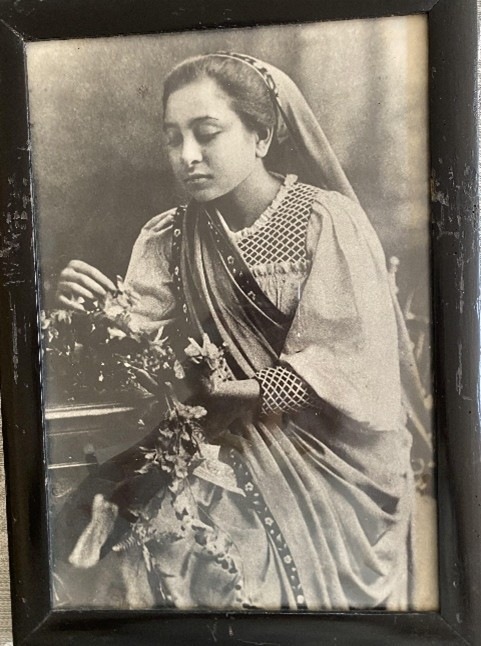
My Mamaiji, Navajbai — shown here in her early days — was head of our joint household. I recall her as a very simple, sweet old lady, always in a white muslin saree and blouse (as she had lost her husband at a young age), sitting and praying in an easy chair all day. If the ‘rama’, Manyo, happened to cross her path, she would mutter under her breath and shoo him away. While we questioned how the appearance of poor Manyo could possibly spoil her prayers, we deeply respected her faith.
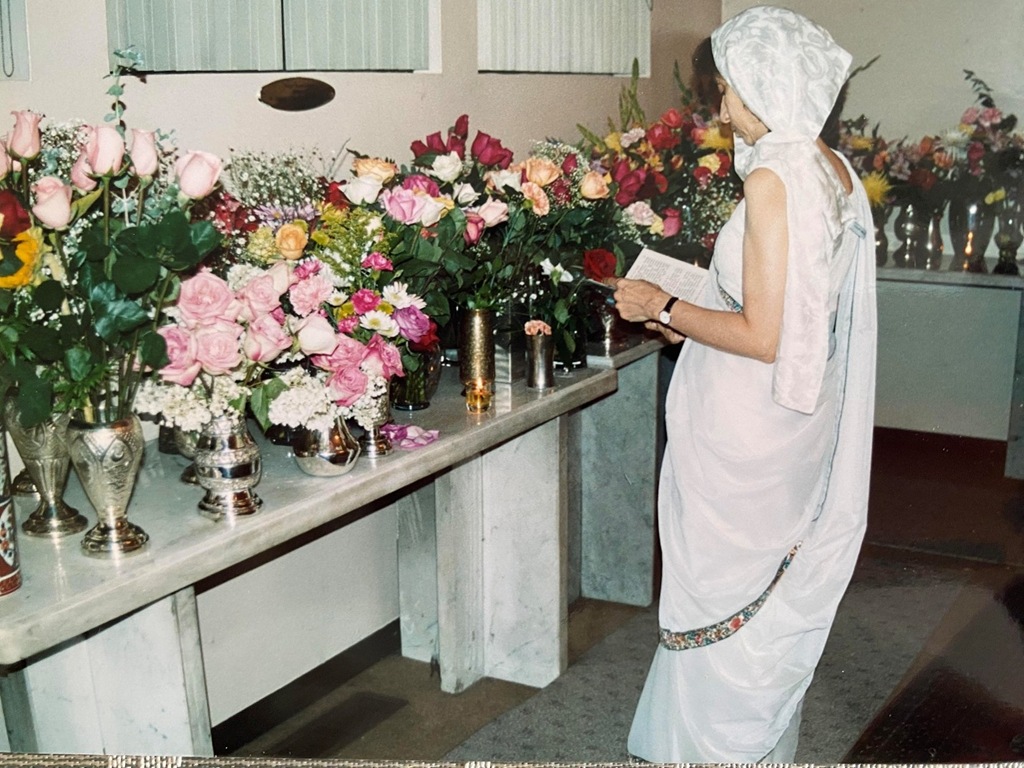
The approach of Muktad days was very special in the Panday household. There was a special “bhunvano oddo” (prayer room) set aside for prayers. The whole house was cleaned and swabbed, and the ‘muktad na vase’ — each one inscribed with the name of a dear departed — were taken out from the large wooden ‘peti’ (trunk), polished, and laid out on the marble table, filled with roses and ‘goolcheri’ lilies. The Mobeds recited Muktad prayers and read the names of the dear departed every day, for 10 days (or was it 18 days?).
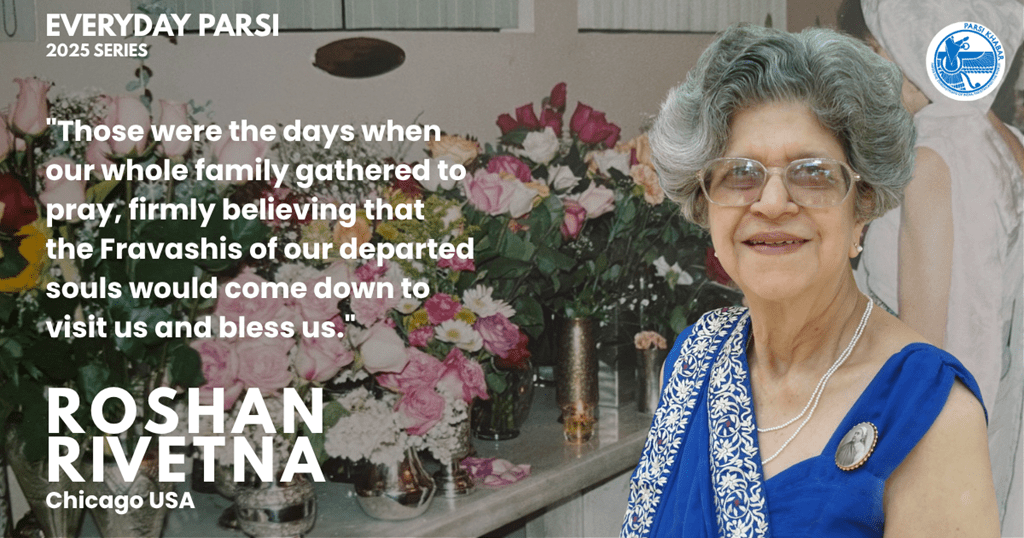
Those were the days when our whole family gathered to pray, firmly believing that the Fravashis of our departed souls would come down to visit us and bless us. It was very comforting to take some moments from our busy lives to sit in peace, reflect on our near and dear ones who had left us, and seek their blessings.
Muktads in Chicago
The few families in Chicago in the 1960s made attempts to set up Muktad in each other’s homes, but it was not until after the Arbab Rustom Guiv Dar-e-Mehr was built in 1983 that the community realized the value of this shared experience.
We are deeply grateful to the Mobeds of Chicago and to all those who come together to organize the Muktad prayers for five Gatha days at the end of the year at the Dar-e-Mehr. It draws a large number of people — some of whom come to the Dar-e-Mehr for only this one occasion every year.
It is truly a breathtaking sight, with long marble tables in the Prayer Hall, dozens of silver vases filled with fragrant, fresh flowers, and flickering divas. With all that is happening around us in the world these days, these are a few moments of peace and calm. As we sit there and feel the spirit of our dear departed around us, we reminisce about our lives, pray for their souls, and look forward to another year ahead with the blessings of our loved ones.
We truly hope that this tradition will endure for future generations in North America.
About Roshan Rivetna
Roshan Rivetna is perhaps best known for her stewardship of FEZANA Journal (1991-2005) and her publications “Legacy of Zarathushtra”, “Zoroastrian Connections with Judaism and Christianity”, “My Mother Used to Say,” and her demographic studies – “The Zarathushti World – a Demographic Picture” [FJ, Fall 2013]. Her efforts at bringing Zoroastrian singles together, were featured in New York Times [2009]. With her collection of floral decorations and ‘mandap’, Roshan is often called upon for gala events. She offers culinary delicacies (www.ParsiCuisine.com/ParsiMithaiShop). Roshan pursued a career in Nuclear Physics at Tata Institute of Fundamental Research, Argonne National Laboratory and AT&T Bell Laboratories.